
The Seven Sins of Pet Friendly: The Undefined Claim
A review titled "Not pet friendly, pet tolerant" says it all. A dog owner read the listing and did everything right, yet at check-in they faced a surprise non-refundable fee and were told their dog was banned from the restaurant, bar, and holiday spaces. The "pet-friendly" label lied to them.


Last year I read a hotel review titled "Not pet friendly, pet tolerant." Underneath it, a dog owner described booking a room advertised as pet friendly, paying a non refundable fee they only discovered at check in, and being told their dog was not welcome in the restaurant, the bar, or any of the spaces that make a hotel feel like a holiday. They had done everything righ, they had read the listing.
The listing lied to them, and it lied to them using two words that the entire hotel industry treats as meaningful. But they are not meaningful.
They are meaningless, dog and cat owners know it.
It is the whole problem, and it is the first of seven sins I am going to lay out.
This is part one of the Seven Sins of Pet Friendly, in which we discuss the damage done to our industry by an undefined claim.
Let me first be clear about what I am not arguing, because some people misread me every time. I am not saying hotels should stop charging for dogs. I am not saying they should tear up the house rules, ignore allergen liability, or pretend that a Great Dane and a teacup poodle are the same booking. Dogs cost money.
A badly behaved dog can genuinely wreck a room, and the hotel, not the guest, eats that cost. Those are real concerns and I have never once pretended otherwise.
The problem was never the rules.
The problem is the two words hotels hide the rules behind.
A word with nothing behind it
"Pet friendly" has no definition. There is no legal standard for it, no published criteria, no audit, and nobody checking. It is not a category, it is a claim, and it is a claim the hotel writes about itself. Any property on earth can type those two words onto a booking page tomorrow morning, and nobody can stop them, because there is nothing to fail. Think about what that means in practice.
The hotel that invested in proper dog beds and bowls, trained its staff, opened its bar and its grounds to dogs and charges a fair fee that actually covers something, sits behind the identical label as the hotel that ticks a box on a booking platform and relegates every dog to a tired room next to the bins on the ground floor.
Same two words. Pet-Friendly.
The guest has no way to tell them apart until the money has changed hands.
When I assessed more than three thousand hotels across more than fifty countries against a defined standard, forty ninish percent of the properties calling themselves pet friendly scored a D or an F. Not because dog owners are fussy. Because half of the hotels using the words were not delivering anything that resembled the welcome the words imply. The failures were structural, not incidental. They were baked into a label that asks nothing of the hotel and promises everything to the guest. It is called misleading marketing.
Good hotels lose the most
Here is the part the industry has not understood, a meaningless label does not hurt the bad hotels, it protects them. It is the good hotels that end up losing out.
If you are a hotel that has genuinely done the work, the undefined claim is your enemy. You spent real money making your property a place dogs are welcomed rather than merely allowed, and the reward is that you get filed in the same bucket as every property that did nothing. The traveller cannot see your investment through the noise, because the word that should signal it has been worn smooth by everyone who slapped it on without earning it. You are paying for quality and competing on a label that quality cannot win.
This is why dog people do not believe the words. Cat people never did.
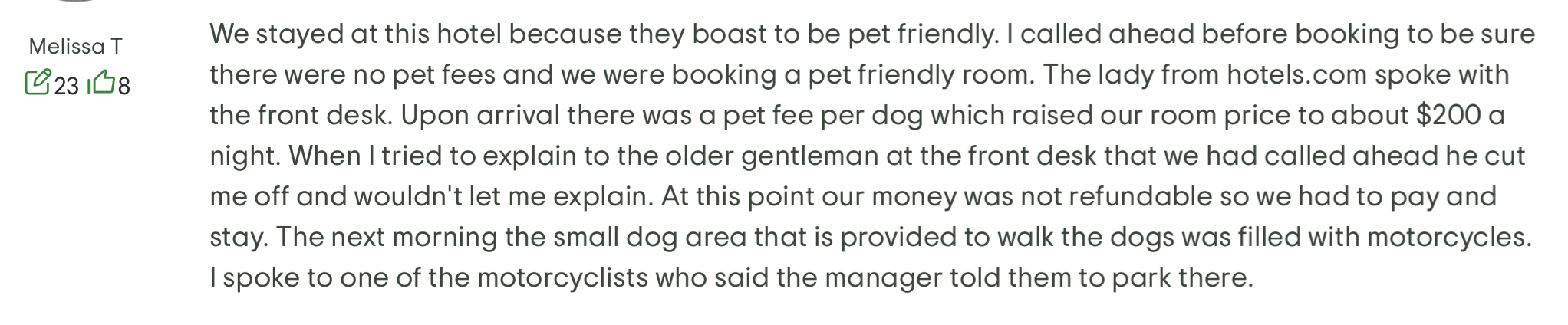
Their reviews tell the whole story. "Fake pet friendly hotel." "Not actually pet friendly." "Pet tolerant, not pet friendly." Check for yourself, read enough of them and a pattern emerges that is impossible to unsee. People are not describing isolated bad hotels, they are describing a label that has detached from reality across an entire industry, and they have invented their own vocabulary, pet tolerant, to name the gap that marketing refuses to admit.
Allowed is not the same as welcomed
This is the distinction the whole thing turns on, and it is worth saying. Allowed is tolerance wrapped in fine print, welcomed is a standard you can point to. The moment a traveller learns to ask which one a hotel actually means, the marketing word losesits power, and undermines what little credibility your hotel had.
Consider the absurdity it produces.
A calm, house trained, fully insured adult dog is charged a nightly fee and confined to certain floors, while two floors up a family checks in with a toddler who will throw food at the walls, scream through the night, and crayon the furniture, and pays nothing extra and goes anywhere it likes. I am not arguing we should charge the toddler in any way. I am pointing out that a word doing this much quiet discrimination, with this little honesty about it, has no business being trusted.
Regulators are catching up to the same conclusion from a different direction.
The 2025 Federal Trade Commission rule on unfair and deceptive fees now requires hotels to disclose mandatory charges up front, precisely because surprise fees at check in destroy trust. A pet fee that materialises only after a non refundable booking sits squarely in the drawer regulators have already labelled deceptive. The wind is blowing one way on this, and it is not the industry's way. It is a consumer protection issue hiding in plain sight.
Cat owners know pet-friendly excludes them
Before anyone reaches for that rebuttal, look at what the word actually does to people who do not even own dogs. "Pet friendly hotels" will not admit that it almost always means dogs, and very rarely means cats, despite the word "pet" plainly promising both. Cat owners discover this in the fine print, after booking, the same way dog owners discover the fee.
It leaves cat owners feeling misled by both the term and the hotel using it.
The sin here is not being specific about which animals you serve. A hotel that serves dogs and not cats is allowed to make that choice. The sin is hiding it behind a word vague enough to imply otherwise. An honest property names exactly what it offers and proves it, a dishonest one shelters behind two words that commit to nothing and can therefore never be held to anything.
You know this of course, I do not need to tell you. Only 7-12% of "pet-friendly" hotels accept cats, so what "pets" are you talking about exactly? And why are you excluding cats from your definition? You mislead cat owners.
What replaces it
The answer is not to ban the words, and it is not to shame hotels for charging fairly, the answer is to replace a claim with an honest, clear standard.
The answer is a defined standard assessed against published criteria and verified independently of the hotel's own marketing claims.
That is the principle behind the Dog Friendly Standard, and why we assess hotels across 70+ data points, judged by someone other than the hotel writing its own marketing copy. Dog friendly, defined and verified, is the exact opposite of pet friendly, claimed and unproven. One is a tickbox a hotel awards itself, the other is a grade a hotel earns. Until there was a standard, we could not tell the difference.
Now there is, now they can, and now they do.
This is the first of seven sins. The undefined claim is the foundation the other six are built on, the hidden trade off, the deterrent fee, the absence of proof, the broken filter, the fake clean room, and the species bait. I will take them one at a time, because the industry has leaned on these two words for so long that it has genuinely forgotten how little they mean.
So the next time you see a hotel call itself pet friendly, ask the only question that has ever mattered. Who checked? Nobody checked is usually the answer.
A marketing term that excludes half of pet owners by default and misleads the other half is not good marketing. It is a misleading practice that undermines trust in the entire category, the second or third most searched for category in the industry. Except now, increasingly, they are looking for real "dog friendly".
And who can blame them? Nobody calls their dog a pet.

Need a hand? Talk to Kali.
Our free dog‑friendly concierge knows where you and your dog are genuinely welcome to eat, drink, stay and walk, plus the nearest emergency vet when it matters. Instant, in any language.