
The Podenco Ibicenco: Ibiza's Hound and the Pharaoh Myth
The Podenco Ibicenco is Ibiza's own hunting dog, a tall red and white hound that runs down rabbits by scent and sound. Every breed page says it sailed from the pharaohs' Egypt. A 2023 genetic study tested that story, and the island tells a different one.
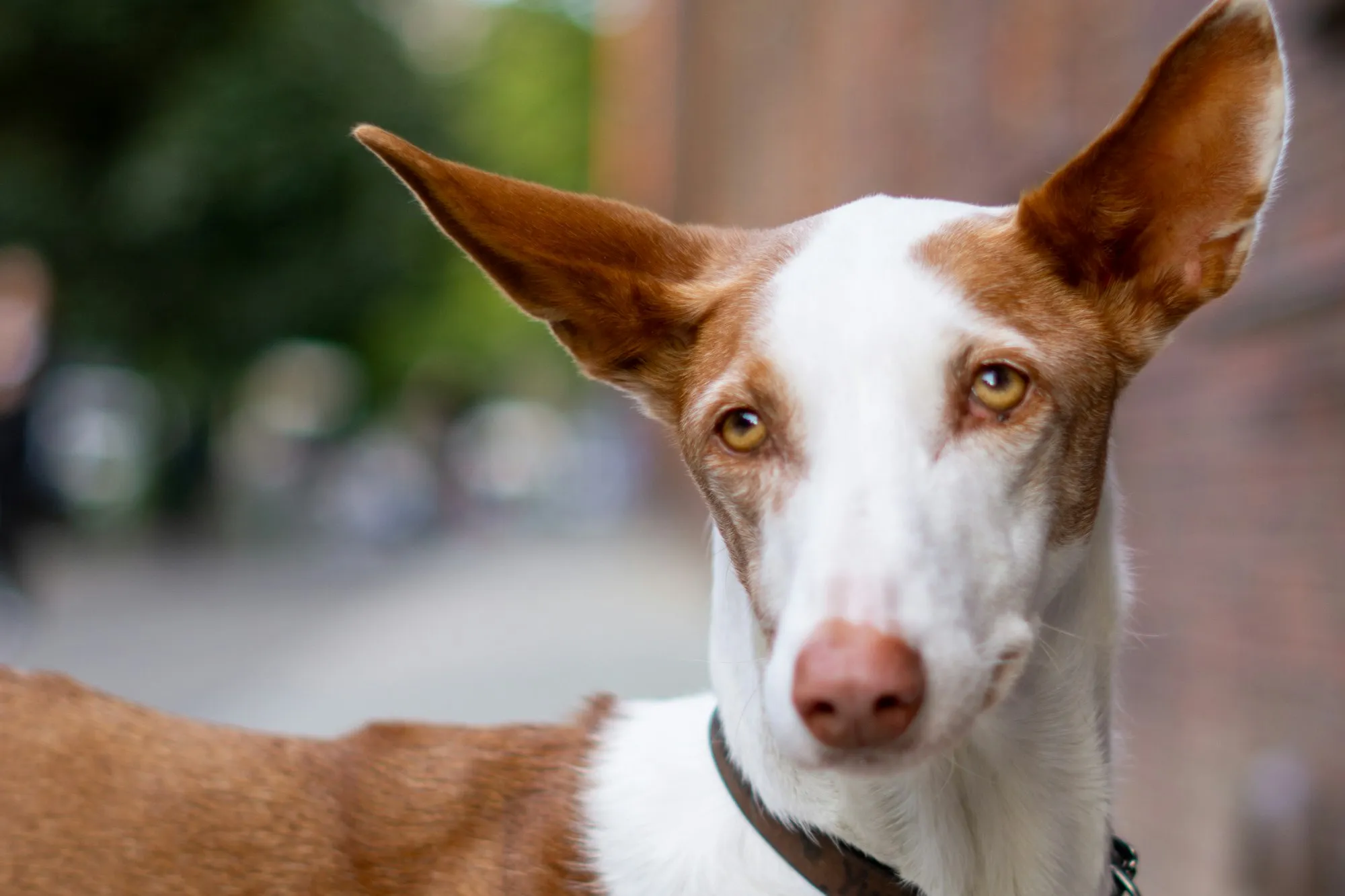
When a pack of Ibizan hounds has caught several thousand rabbits, some of the dogs simply stop. They will not hunt again until they have had a long rest, and the islands have a word for it, enconillarse. That detail sits in the breed's official standard at the Fédération Cynologique Internationale, among the measurements and the faults. The Podenco Ibicenco, the Ibizan hound, is a tall red and white hunting dog with upright ears and amber eyes, bred in the Balearic Islands to find rabbits in thick scrub and catch them without a gun, by day and at night.
The standard is precise about how it works. The hound uses its nose and its ears more than its eyes. When one dog finds game, the others surround it and wait at a distance, barking only once they have seen or heard the rabbit, every tail going fast. Packs are made of bitches, with one male at most, because the males quarrel and will not work together. Dogs stand 66 to 72 centimetres at the shoulder, bitches 60 to 67, and the coat comes smooth, rough or long, preferably white and red.
The Pharaoh Story
Read almost any breed page and the Ibizan hound arrives from Egypt, a dog painted on tomb walls five thousand years ago and carried to Ibiza by Phoenician sailors. The FCI standard tells the same tale. It says the dogs were probably brought to the islands by the Phoenicians, Carthaginians and Romans, and that illustrations in the graves of the pharaohs prove the breed existed in 3400 BC. A picture of a slender dog with tall ears on a tomb is a picture of a type, though, and a type can arise in more than one place.
In 2023 a team led from the University of Perugia, with the University of Zaragoza among its partners, put the story to the test. Their paper in Research in Veterinary Science sampled 272 unrelated dogs from eight Mediterranean hound populations, 38 of them Podenco Ibicenco, alongside Egyptian Baladi street dogs. None of the breeds turned out to be a direct descendant of the Egyptian dogs. They still look like the dogs in ancient Egyptian art, and they share some genetic links with Egypt's dogs today, which the authors read as old lineages spread around the Mediterranean, quite possibly on Phoenician ships in the first millennium BC.
The paper also cites earlier whole genome work finding that the Ibizan hound, Malta's Kelb tal-Fenek and Sicily's Cirneco dell'Etna are close relatives, but that each became a separate breed only within the last two hundred years. The authors are careful to say their markers tell only part of the story. The pharaohs' hound is a resemblance and a romance, not a pedigree.
Whose Dog Is It
What the islands argue about is not Egypt but Mallorca. The FCI standard says the breed belongs to Mallorca, Ibiza, Menorca and Formentera, and lists the other names it goes by in Catalonia, around Valencia and in the south of France: Mallorquí, Xarnelo, Charnegue, Balearic Dog. On Ibiza it is the ca eivissenc, the Ibizan dog, and the island has fought to keep it that way.
In March 2003 the Periódico de Ibiza reported that the breeders' association of Ibiza and Formentera was refusing to share the breed's official seat with Mallorca. The stud book had been kept in Castellón on the mainland, and a royal decree of May 2001 required it to move to the breed's region of origin. A Mallorcan society wanted it too. The association's president, Antoni Serra, told the paper the podenco was part of Ibiza's cultural heritage. Five years later the Catalan magazine El Temps found the office settled on Ibiza, and the breed expert Antoni Pedró Marí still uneasy that Mallorcans wanted it called the Balearic dog, or even the Mallorcan dog.
A Working Hound Still
On Ibiza the podenco is not a relic. The island's government, the Consell d'Eivissa, writes rules for it into the hunting season. The 2018 to 2019 season resolution allowed a lone hunter up to ten dogs for rabbits and two or more hunters twelve, with groups of four hunters and twenty dogs on estates that gave notice. It also opened special August days for hunting with the ca eivissenc, explaining that they were meant to honour the heritage of a native hunting breed under the Balearic hunting law. The 2020 season did the same in July and August, with two of those days reserved for hounds entered in the breed's stud book.
That 2018 resolution opened the rabbit on the island's estates from 29 July to 6 January, and until small game opened in the autumn it could be hunted only with dogs, never a gun. It is the hunt the FCI standard describes, and El Temps called the sight of the hounds leaping over the scrub after rabbits unforgettable.
The Law and the Hounds
Spain's animal welfare law of 2023 does not reach the hunting hound. Article 1 of Ley 7/2023, on the rights and welfare of animals, lists what falls outside its scope: bulls in the ring, farm and laboratory animals, wild animals, sheepdogs, rescue and police dogs, and, in its own words, perros de caza, rehalas y animales auxiliares de caza, hunting dogs, hunting packs and other animals used in the hunt. The law says those animals stay protected by the European, national and regional rules that apply to them.
The criminal law is another matter. On 22 July 2026 the Guardia Civil's nature protection service went to a rural property in Sant Josep de sa Talaia after reports that several Podenco Ibicenco dogs had been left in critical neglect. The Periódico de Ibiza reported that officers found five dogs, one apparently dead and the others starved and dehydrated, with empty bowls and no clean water. The surviving four went to the island's animal protection centre, and the man responsible for them was investigated for the crime of animal abuse.

Bringing Your Own Dog
A visitor's dog meets Ibiza on the town council's terms. The Ajuntament d'Eivissa keeps two stretches of coast in the town open to dogs all year. At es Viver it is the 360 metres of shore between the streets Quartó de Balançat and Quartó de Santa Eulària des Riu, marked with signs at each end. The second runs from Carrer de Benirràs to the edge of the municipality, by ses Figueres. Dogs walk to both on a lead, owners carry the dog's papers, pick up after it and keep it under control, and dogs classed as potentially dangerous wear a muzzle.
On the town's other beaches dogs are allowed through the year except at weekends and on public holidays, and not at all from the start of Holy Week to 31 October. Fines run from 751 to 3,000 euros. So the season for a dog on Ibiza's sand is the quiet one, November to Easter, which is also when the hounds are out in the hills. El Temps described the ca eivissenc as a common sight in the woods and fields of Ibiza and Formentera, out with the hunters, at home as a companion, and sometimes running wild. Take a winter walk inland and the island's own dog may well be the first one you meet.

Kali Concierge
Travelling with your dog? Ask Kali.
Where your dog is genuinely welcome to stay, eat, drink and walk in 50+ countries, how to cross borders with the right paperwork, and calm emergency medical advice with the nearest 24-hour vet. Free, day or night, in any language.