
Interesting Journeys Into Petpreneurship: Mindy Dutka
An interview with Mindy Dutka, founder of Dogs I Meet, whose fusion of entrepreneurial instinct and creative risk-taking made her a commercial dog photographer extraordinaire.
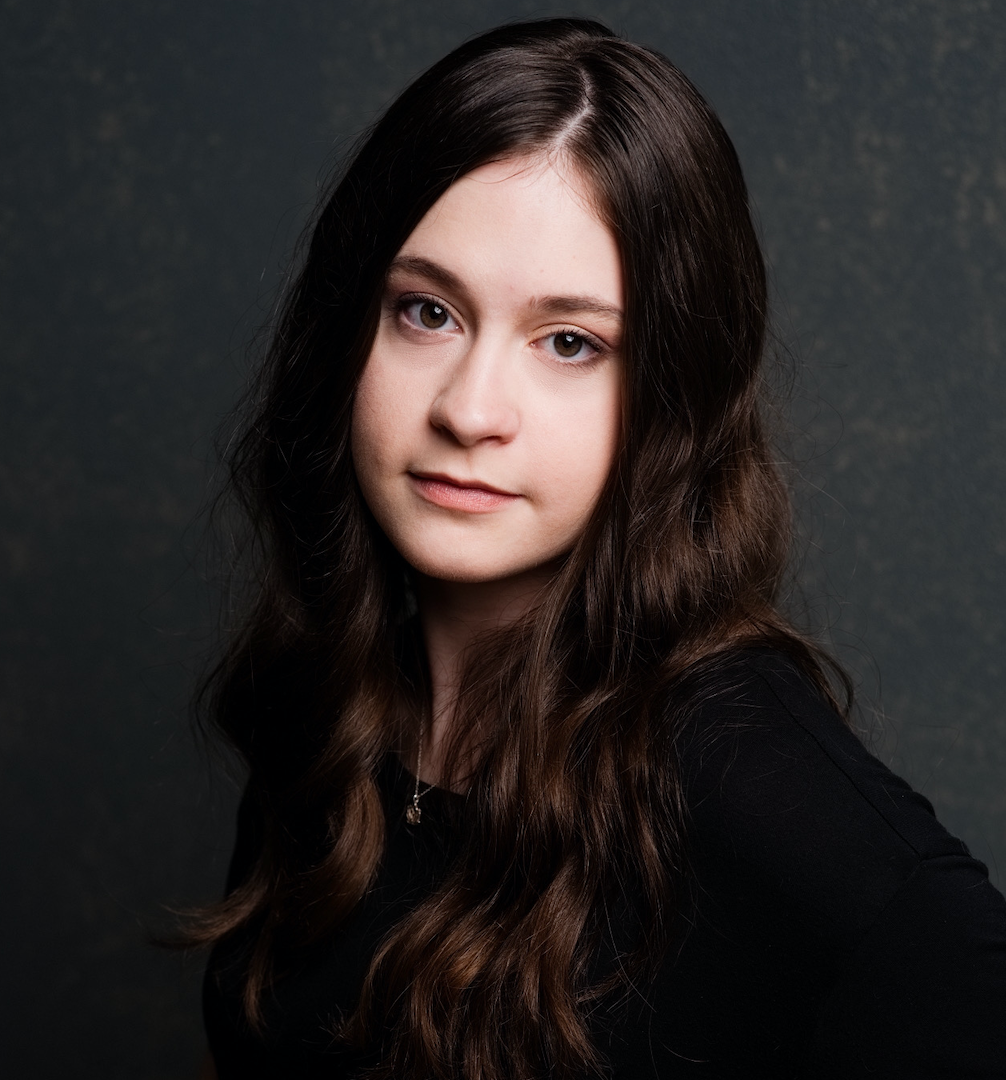
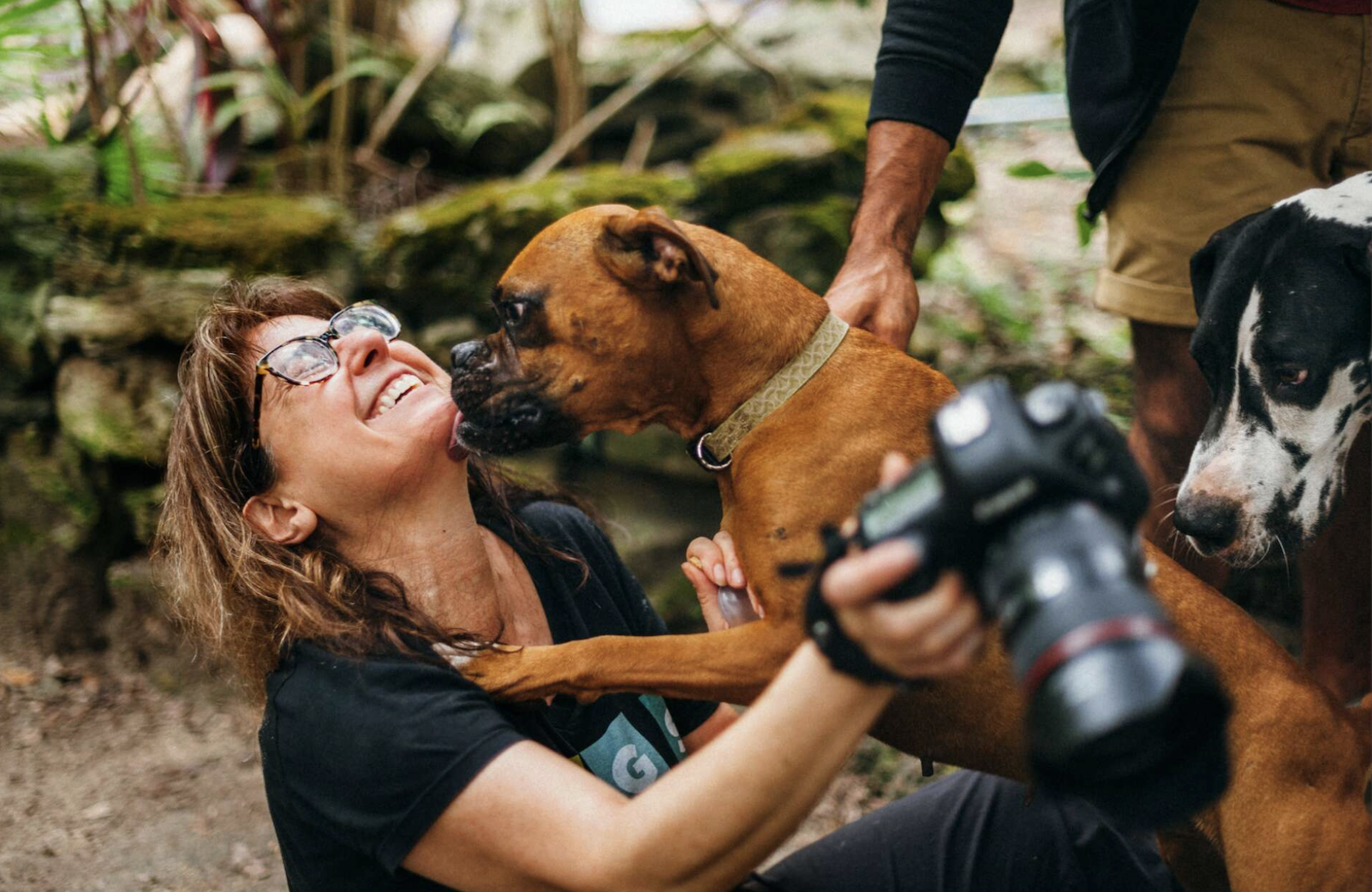
In the latest installment of our Interesting Journeys series, Roch CEO Guise Bule talks to Mindy Dutka, founder of Dogs I Meet, about her career path beginning in sales and event production, and evolving into a photography practice centered on the human–animal bond. From documenting spay/neuter clinics in Mexico and post–Hurricane Maria rescue efforts in Puerto Rico to reimagining brand collaborations that give back to shelters and dogs, Dutka is consistently honing the art of storytelling photography.
Bule: So tell me about yourself, Mindy! How did you get into this industry? What were you doing before? Did it lead you into this?
Dutka: No, it didn't really. I mean, I actually did many different things in my career. I've done sales for Fortune 500 companies. I had my own event company for many years doing corporate events and nonprofit events. That was enjoyable until the bottom fell off in, I think, 2007, and event business kind of went flat. So then I reinvented myself again to a completely different thing. And I sold and managed video and telephone interpreting to hospitals for people who don't speak English.
Bule: Oh, wow.
Dutka: So I've never been fearful of doing something I've never done before. I've always considered that a challenge. And then I reached a point where that really wasn't super– it just– I wasn't fulfilled. And I said, I really want to do something that I love. And I had been giving thought to - how can I work with dogs? But I really couldn't – for years, I couldn't come up with what that would be.
Bule: Let's just drill down into that. Is that something you've wanted since you were a lot younger, since your childhood?
Dutka: Pretty much. But you talk about petpreneurs now...back when I was a child, basically, if you wanted to work with dogs or animals, the only thing people would say was: Are you going to be a veterinarian? And it wasn't as if there were really any other channels or directions. And a veterinarian wasn't for me. All that school and all that science. So I just sort of never even considered it as a–
Bule: I've been hearing that from other founders: 'I always wanted to work with animals, but didn't want to be a vet.' It's interesting.
Dutka: Yeah. I look at it now, and I think, if I were starting my career over, how I could have done these different things and grown in the industry. But they didn't exist. They didn't exist.
Bule: Yeah, you're right. They didn't.
Dutka: And so, yeah, I've always loved dogs. Literally, I think when I was 10, I volunteered for it with the Lost Pet Society. I sold candy for them door to door. I was their number one salesperson. And even when I had my event company and my daughter, we used to do things. I did events in malls for children. So we created a walkathon in the mall, but it was to benefit the local rescue. And my daughter, when she had her Bat Mitzvah, did a bigger mitzvah project than everybody else and raised $10,000 for them.
Bule: Pretty good!
Dutka: Yeah. It was awesome, and it was a great experience for her. So I've always just been interested -
Bule: But it sounds like the real world caught up with you. And you realize you can't work with dogs if you want a real job, right, or a career.
Dutka: Exactly. Exactly.
Bule: How do you make money? What do you do?
Dutka: And at this point, making money was important, but it wasn't my driver. Loving what I did was more of what was driving me to choose what I wanted to do for this next chapter of work. And I literally stumbled upon it because it's kind of funny.
I was choosing things that I felt like I had an interest in. And what could that– how could that become a business? And I felt that whatever I did was going to have to be my business. I didn't think there was something out there that someone was going to hire me for to do, that I would need to create it. And again, I was no stranger to startups. I'd worked for other people's startups. I'd done my own startups.
Bule: The entrepreneurial spirit is strong within you.
Dutka: Exactly. And so I was literally googling and trying to figure out what to do. And a couple of – like a few months before I was making this transition - I was taking a trip to Barcelona. I also love travel, so I generally will do a lot of research. And I also like to do things off the beaten path.
But I stumbled upon something called Barkarica, and it was a retreat for pet photographers that they were holding in Barcelona. And I was like, what? Dog photographer? I never thought that that was a thing, so to speak. And then I was just like, it looks like it is; I think I found what I'm going to do. And I wasn't really sure what you do to become a dog photographer.
That's where the inspiration came from – that I saw that people were dog photographers. And there was a training program to help teach you learn how to take better photos with dogs. I then started exploring that - and that was about, now, close to eight years ago. So it was still– now a lot of people are dog photographers, some more successful than others. But I started Googling and researching, and I came across some information about teaching you how to build a brand around dog photography. So I'm like, yeah, there are two sides of it. There's the creative side, your photography, and there's the business side of it.
Bule: And you, with your background, the sales, the marketing side...
Dutka: Right, which was very helpful to me because I was a hobby photographer, but I didn't train. I didn't go to school. The people that were - the people that I came in contact with, they were photographers. But they oftentimes – not always, but creatives tend to maybe lack on the business side. And any business you go into is only successful if either you've got a partner that's on the business side or you're on the business side. So that was, I'd say, to my advantage of having worked in many different industries and sales and marketing and all of that. So I started putting together a brand. So at least I had an umbrella as I grew and learned.
Bule: The brand is Dogs I Meet?
Dutka: Yes, Dogs I Meet.
Your dog deserves better than "pet friendly." See why →
And I went very literal. When I was trying to decide on the name, first of all, I must have bought 40 domains. I'd wake up in the middle of the night and, actually, if I go back a little bit further, I don't know if you're familiar with Brandon Stanton, the creator of Humans of New York. If you're not, I highly recommend that you look at his work.
Bule: Vaguely rings a bell.
Dutka: So he started about 10 years ago. And he'd stop people on the street and take their pictures. And then he started to ask them questions, various questions. So he'd write little excerpts underneath.
I lived in New York at the time. And I was just fascinated by what he did. I was like, I want to do that for dogs. I want to go around and take pictures of dogs and get the story about dogs. So I actually took the name Dogs I Meet a few years before I started the business. I started going out and taking pictures, but life got in the way; I had a full-time job.
And so now I've decided I'm going to be a dog photographer. I wasn't thinking of the name Dogs I Meet. And then my daughter's like, what happened to Dogs I Meet? Why are you going crazy with all these names? And I'm like, you know, you're right. Dogs I Meet, it sticks, easy to remember. And then the tagline is because every dog has a tail, T-A-L-E, run on the dog's tail. But again, it was always about storytelling. It started more about storytelling for– about the dog. I saw that I could bridge dog advocacy with the stories, and that there were just many stories to tell through the dog.
Yeah, and that's what happened. I started to build on it, doing private commissions for people who wanted to photograph their dogs. And I started that. And I like that! And I still do that, but it's not so much the main part of my business.
I was always more of a B2B than a B2C kind of business. So then I moved on into thinking I would work with brands and photograph for them. Actually, I worked for a few years for the veterinary emergency group, and that was super interesting and was also storytelling-related. Because what's different about VEG - what they're known as– is that they don't separate you from your pet. It's a 24/7 emergency veterinary hospital. And at the time, when I started working for them, I think they only had nine locations. They have about 75 all throughout the United States.
Bule: Wow
Dutka: And the founder knew that it was about this story - what was unfolding in each ER was what their mission was. He had a vision to decorate all of their hospitals with the photos from each hospital because he wanted to honor the staff in each. A wonderful way of doing it. Right? But it's very difficult to take photos inside a veterinary hospital. The lighting is harsh. There are things all around. Basically, you're in the middle of an ER. So they hired me to photograph, and I did a couple of things. I created the art on the walls from my photographs, and then they used it for their marketing. But basically, it was documentary photography. I would stay there for several hours and photograph what came through the doors. And that was– it was a very good experience in a lot of different ways - I mean, my job was basically to be invisible.
There were a lot of layers because people – it was a heightened emotional state. I couldn't get in the way of things, but I wanted to be able to capture it. I didn't want to invade their privacy, but I still wanted to document it.
When I first started, also kind of– I feel like when you're on the right track– I know this sounds woo-woo, but I really believe it. The universe says things just come together. And they come together in the beginning, so it's easy. As you move on in your career, you find out that was great luck. It doesn't always go that way. But I find that things do work like that.
So I had randomly connected with a veterinarian who volunteered in Playa del Carmen for spay/neuter clinics. And I said, who takes the photos? And I actually went to Playa del Carmen. I was there for about four or five days. I started to really use the storytelling as well because I realized I had this powerful tool through my lens, and that I could raise money for people. I could create awareness. I could document what was happening, and it all really centered around the human-animal bond. I think that shows in the photography that I do is that connection. Whether there's a person in it or not, there's still somehow – people never get bored of looking at those photos either, right? So I wasn't afraid to experiment either. And I wasn't, I guess, afraid to fail. Because it takes balls to say, I'm going to Mexico to photograph this spay/neuter clinic when I'd only been doing dog photography for two months!
Bule: Yes! I'm looking at your work now as we talk. And there are some fantastic pictures here.
Dutka: Thank you.
Bule: It's really nice work.
Dutka: And I think a lot of it is my connection to the dogs. I feel like I see the dog. I meet the dog on their level, and that comes through. And some dogs, it just depends on the situation. You have to be able to go with whatever is in front of you and capture it properly. So yeah, I was moving along. And then COVID came.
Bule: Right. So, you were Dogs I Met at this point, or did the brand come later?
Dutka: Oh, no, I was Dogs I Meet. I've basically always been Dogs I Meet. I was doing the dog advocacy work. I was doing the private commissions. And then I started doing more of the brand, started working for the veterinary hospital.
Bule: Would you mind just talking about the advocacy work a little bit more? What did that look like? That's probably my favorite piece.
Dutka: So it was just wonderful. I did the spay/neuter clinic. And from that, I got to know – I called that whole area of Playa del Carmen. I literally photographed probably 600 dogs during that time that I was there. I saw terrible things of the starvation, not at the spay/neuter clinic, but around, of strays and things like that. And I also saw remarkable people – people that loved animals. And they were doing all these things to save and help the animals that they came across.
So I started to connect with the different rescues. And the different rescues could be as much as one person who – a lot of times, it seemed it was women more than men, and more middle-aged women that were doing it. Again, not always.
I started to get involved with these other rescues. I started to do photographs. And then I actually – somebody very surprisingly, I started promoting it. I tried to raise money for them. And I wound up getting – someone that I knew, that I was really surprised about, gave me a $10,000 donation. That was awesome. And that just fueled me. I was able to divide that up amongst the rescues. Went a long way, yeah. And I started to see that, well, I'm onto something here.
Bule: You can move the needle. You can do a lot of good, yeah. It'a a nice feeling.
Dutka: Very nice feeling. And then it started to become more than a job. So then I actually connected with somebody who had a nonprofit who really loved what I was doing, and they were funding rescuers in Puerto Rico, helping them feed the animals and so forth. And then Hurricane Maria came, and it was awful. They invited me to travel with them to photograph the aftermath of it. So these experiences of going to that spay/neuter clinic in Playa del Carmen and going to Puerto Rico and seeing things and witnessing and documenting things were really life-changing.
And then I started working on raising money for the Puerto Rico rescues. And then it wasn't until a little bit later – I have to give a shout-out to LinkedIn because I was always, all throughout my career, on LinkedIn. But through LinkedIn, I had connected with a veterinarian who actually ran a high school. He was connected with Tufts Veterinary School. And there's a school in – I think it's in Shrewsbury, Massachusetts. And I think Tufts at Tech, I'm not sure of the name of it. But it's a high school that's for kids who don't want to go on to college. And they teach them a trade. And Vet Tech was one of them. It's a wonderful program.
He was very interested in the work that I did in Puerto Rico, and we were on the cusp of trying to create a visiting veterinary student clinic. So basically, he had access to all of these veterinarians and veterinarians in training. And vet techs could rotate staying there for a little while in Puerto Rico. And they gained knowledge and expertise. Great idea. Right? We were all set. We were making a trip to Puerto Rico because it's very difficult to do things from afar. You kind of have to be there to get people to trust you. And we were ready to go for a trip scheduled for, probably, March 30, 2020. I'm not sure of the date. But, due to COVID and the shutdown, that never happened.
Bule: Oh, so you just couldn't get out there?
Dutka: No, it never happened because of the lockdown. And the same thing happened with the veterinary clinic. I couldn't work for them anymore because A, you couldn't travel, and B, people weren't allowed in the veterinary hospitals.
Bule: What did you do?
Dutka: So I didn't do anything for a while. Actually, I had gotten sick as well. I had a very bad version of COVID. And I wasn't really – I was working on my health and lamenting all the loss. And now what? I've created this great business of all the pieces that I love, and travel was an important part of it. And photography is an in-person thing. So I really – it was probably like four months, five months that the only thing I did do was LinkedIn. I was on LinkedIn all the time. So I started making all these different contacts through LinkedIn.
And then I read a book– I think the guy's name was Chase Jarvis. He's a photographer. He created CreativeLive, which is a school for creatives, and he talked about the importance of doing personal projects that you're passionate about. And I started thinking, I have to be working. If I don't get out there and do something, it's going to be all for nothing. People will forget your name.
So at the time, I don't know if you heard of this; it was called the Front Porch Portrait Project. It was started by a photographer who actually lived near me in Newton, Massachusetts, who came up with the idea that she photographed people using a telephoto lens on their front porch, of like a series of COVID. And she didn't take any money. She donated. People paid for the pictures. And she chose charity. She raised quite a bit of money doing it. She actually wound up getting a book. But I was like, oh my god, what a brilliant idea! And how fabulous, bringing people together. I'm like, I'm going to do front pooch. So I connected with a rescue that I'd been working with. And I was just like, hey, I'm going to do this fundraiser for you. And I'm going to take pictures of people with their dog on their front porch. So I started doing that. And it got me back out there, back in the game.
Bule: I bet people love those – helping you with those pictures too, right?
Dutka: People did! And then the next thing was, I was like, well, let me think of another project to do. And I had spent a lot of time thinking about how dogs were the unsung heroes of COVID, or among the unsung heroes.
Bule: Yes, they were, absolutely.
Dutka: Yeah. It was their moment. So I did a project called Tales of Support. I probably did – oh, I don't know, maybe 30 interviews. It's on the bottom of my website. You can see some of the projects that I did. And I tried to – I didn't want it to be trite, and people just be like, yeah, my dog's my best friend. I was looking for all kinds of different people: health care workers, families, a variety of different people. I interviewed some vet students. And I just got beautiful stories and beautiful photos. And that gave me content, also, on LinkedIn. It brought me back to life. And then things started to open up. And I just moved into going back to doing some work for VEG and doing some other work and getting some other brands and just transitioning back in.
Bule: So your business came through LinkedIn, the strength of your network on LinkedIn, and your network grew, driven by this incredible content you've created for these wonderful causes.
Dutka: Exactly. And then I felt like there was a way to do more because the pet industry is booming. $350 billion globally, I think, projected to be close to $500,000 in a few years. But it doesn't seem like that money, very much of that money, is going to help animals. The dogs are driving it. And the dogs need help. And it doesn't really seem like the right ratio.
So I, at least in my small corner and my way of doing something, want to change that. I sort of shifted what I'm doing. What I call it is bridging dog advocacy through brand marketing or using storytelling photography. So, some of the things that I do are, for example, if a brand hires me, I will work with a shelter and use the dogs from the shelter as the dog model for whatever I'm doing. And part of the fee, which is built in, the shelter gets a donation right off the bat because there are also all kinds of issues with the shelter being short-staffed, and I need someone to work with me. So I want them to know there's something in it for them. And then it becomes a layered story. So that dog gets professional photos, which helps it to get adopted. The rescue gets some promotion and exposure out of it. The brand gets a layered story. It's really been interesting. I've been able to do a few things like that that have been very successful.
And then also rescues have a pretty good – not all, but a lot of them have a good social media following. So the brand benefits, but then whatever those pictures I took, the rescue has to push those photos out on their social media. So there's more exposure. I've seen – I did one for Virgin Hotels in New York, and then there's a pet food company, pet treat company, called Shameless Pets.
What they do is – they call it upcycle. So there's a lot of food that goes to waste. And there's nothing wrong with the food. It just doesn't look pretty. They use that food. They buy that food to produce their pet food. So they have an interesting story in themselves, but I was going to be doing a photo shoot for them because Shameless Pets collaborated with Virgin Hotels. That's a dog-friendly hotel, and when you go there, and you check in, you get Shameless Pets treats. So that's where that brand collaboration is.
Bule: Moving on to our penultimate question. What advice do you have for aspiring petpreneurs trying to move into the space? What advice do you have to offer them?
Dutka: Just get in and do it. And don't overthink it. But be tenacious. Some things are going to work, and some things aren't going to work. And if you're at this end of your career and you see, I actually see – I use all the things I learned that I was wondering why I was doing them back then. I'm using them now to put together. So be tenacious and go for it. Hold faith. Other dots will connect in the future.
Bule: And finally, are there any founders or companies or things you want to shout out there?
Dutka: Definitely. One is called Zounds. Derek Garrett is the founder. Really interesting story as well. He's a record producer. He's been a producer for some well-known names that I don't have off the tip of my tongue. But Zounds is his passion project. So it's been scientifically proven that music can ease anxiety in animals. And it's a certain kind of music, which he understands because he's a producer. So he's created the actual type of music that eases pet anxiety.
The idea is to have it in veterinary clinics, people's homes, but the real key is the shelters. So he actually donates – he donates to a shelter, Zounds, which is an app. But what he found, similar to what I found, is that it's not always so easy to go to the shelter and say, I want to make things better for you. There's a resistance to anything that they see as more work. But what they found is that, particularly in the larger shelters, they play the music all night long. And the people come in – the workers come in in the morning and say, rather than a cacophony of dogs barking and whatever, they're quiet and sleeping in their cages. So it really makes a difference. And if you take that and you go adopt, the adopter gets the act and plays it at home. There's a continuity that helps it. So he's doing a lot of great things, for sure.
Bule: There's a continuity that comforts the dog there. How interesting.
Dutka: Oh, one more is called VetBilling. So basically, with vets – as we all know, it's pay, or we can't treat. They don't want payment plans. They don't want – there aren't a lot of options for people. When they go in, it's sticker shock. Something happened. It's $5,000. And it's like, wait...it could be fixed. I just don't have the $5,000. So VetBilling is a payment plan; they handle all of the logistics and all of the hassles. And I think they have something like a 93% payback plan. It's not that people don't want to pay; it's just that they can't pay right now. But a lot of veterinary clinics, again, because of the private equity, are hesitant. They just don't want anything to do with it. But I think it's a wonderful resource. Helpful to a lot of people out there. So that's another one that I want to shout out.
Bule: Definitely worth a shout out, yeah. Thank you, Mindy. That was brilliant. Thanks for sharing your journey.
Dutka: Thank you!
Travelling with your dog? Find certified hotels →
This concludes our interview. Please give Mindy Dutka and Dogs I Meet a follow on LinkedIn, Facebook, and Instagram.