
Iason Koufodontis on What Makes a Hotel Pet Friendly
A student's thesis question led Iason Koufodontis of the University of the Aegean to write the first academic definition of pet friendly. He tells us how he got there.
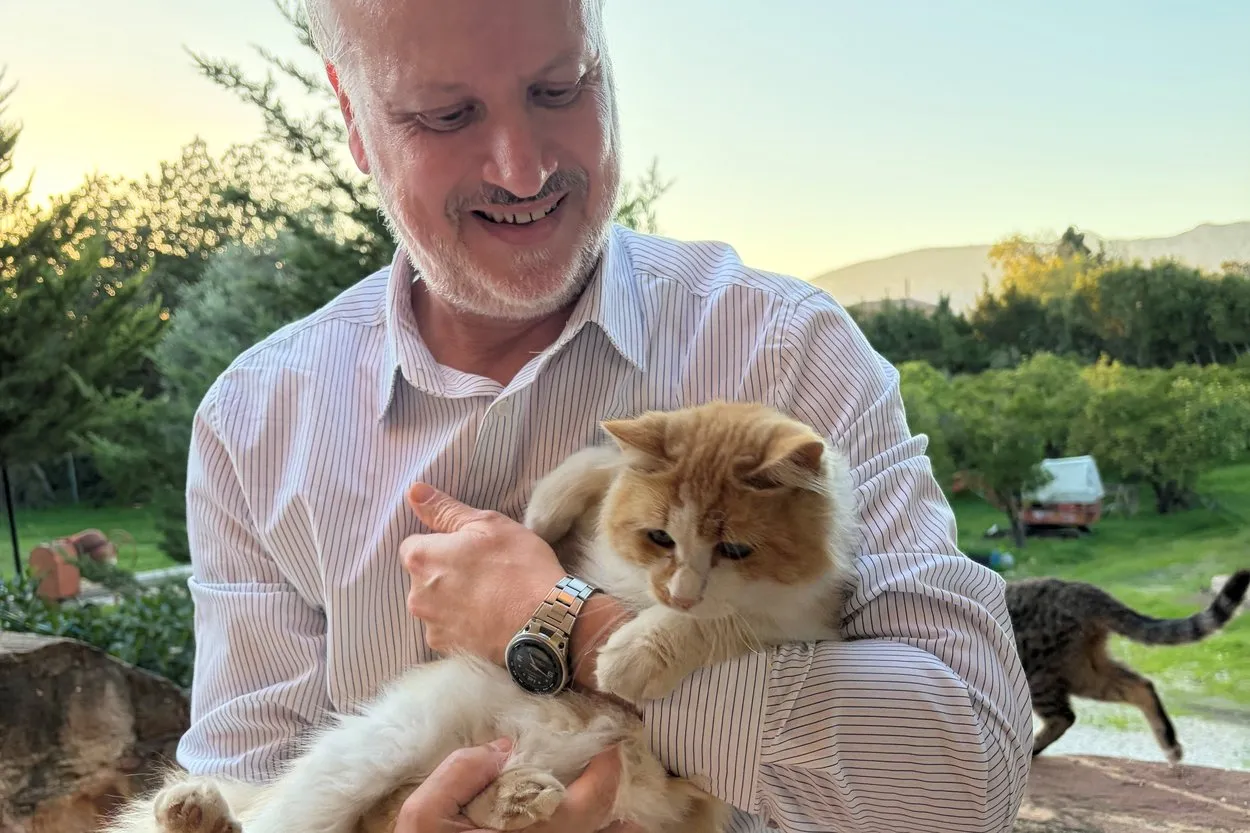
Iason Koufodontis did not set out to study dogs in hotels. A master's student asked him to supervise her thesis on pet friendly hotels, and worried that she could find almost nothing written on the subject. That gap bothered him enough to go looking himself. Some years later he has done what nobody in the industry had done: he asked 1,041 people in 66 countries what "pet friendly" means to them, and wrote the first academic definition of the words.
He teaches tourism economics and management at the University of the Aegean in Chios, Greece, and he came to the subject honestly. He grew up in a family that took its animals along on its travels, including two ducklings called Donald and Daisy who rode the ferries in the bathroom sink. Today the household runs to seven cats, one of them Sir Bob, who shares the photograph above. He is a dog person too.
His paper, Pet-friendliness in hospitality and tourism: Definition, scope, and governance, is free to read, and we turned it into a version for hoteliers, More Than Permission. Welcome to another chapter of Interesting Journeys. I put eleven questions to Iason, and this is how he got here.
It would be better to just declare that you are not allowing pets, instead of having some vague pet-friendliness label that will eventually lead to service failures, disappointment, and a negative impact on your hotel's reputation.
Bule: What first drew you to study pets in hospitality and tourism?
Iason: Many years ago, I had a master's degree student who asked me to supervise her thesis on pet friendly hotels but was hesitating because she could locate very few relevant academic sources. That intrigued me enough to take a much deeper look at the topic as it was very close to my research expertise in hospitality innovation and entrepreneurship.
Bule: Do you travel with an animal yourself, and has that shaped the work?
Iason: My family has always had animals and in the past, we often travelled with them. I remember as a little kid, travelling with our pets, even with some less common ones. For instance, on one trip we had two ducklings, Donald and Daisy, who were more than happy to hang out in the bathroom sink of ferries and hotels! But nowadays, as we live in the suburbs, our pets stay at home under the care of relatives and friends, so they always remain in a familiar environment. But if I didn't have the luxury of caretakers, I would definitely be doing a lot of searching and preparation for travelling with my pets.
Bule: Everyone uses the words "pet friendly", yet your paper is the first to define them. Why had nobody pinned it down before?
Iason: That's something that surprised me a lot. When writing about the topic, about any topic as a matter of fact, the first thing you should state is the definition of your subject. Yet, although relevant literature had started to emerge, I could not find any scholarly and widely accepted definition about what the term actually means. Thus, I decided to do some highly focused research on that. I dedicated a lot of effort, both time and money, to gather what would be a series of robust and reliable global samples, allowing me to finally define the meaning and scope of pet-friendliness with high confidence.
Bule: In a sentence or two, what makes a hotel pet friendly?
Iason: In services marketing there is extensive theory about customer satisfaction and service failures. One of the key failures is the potential gap between the customer's expectations and the actual experience. When a hotel is not clear about what the pet owner should expect, then it is almost certain that such gaps will develop, leading to customer disappointment. So, to me, a truly pet-friendly hotel is one that meets guests' reasonable expectations regarding the treatment of their pets, without unpleasant surprises or disappointments.
Bule: Your respondents said permission alone is not enough. What did they say a hotel needs beyond letting the animal in?
Iason: A hotel needs to have specific things; rules were among the most prominent ones. However, after studying tens of thousands of relevant online reviews of customers over the years, I would say that staff training and attitude, including explanation and enforcement of rules, seem to be among the key factors for success or failure.
Bule: Only about one in ten would accept high fees or limits on which animals are welcome. Did that surprise you?
Iason: It is an interesting finding. It does warrant further research and my first thoughts are that it is not about money (academically one could examine elasticity of supplementary services pricing) but it could be more about how pet owners might be seeing pet-friendliness as part of the core of the service and not as an add-on that justifies extra fees.
Bule: American travellers were far more tolerant of restrictions than Europeans. Why do you think that is?
Iason: When designing the study, I was expecting to find differences based on the location of the respondents. I would have been skeptical about the result regarding America but since I had an additional independent sample especially for the US, I was able to confirm that this is indeed an established pattern. Beyond the observation, I do not have enough information to suggest any specific reasons and would like to research it further.
Bule: When is a restriction fair, and when does it stop a hotel being pet friendly at all?
Iason: Restrictions (should) serve one purpose and one purpose only: safeguarding the wellbeing of all stakeholders: guests with pets, guests without pets, employees, and of course the pets themselves. Whenever the reason for a restriction is not clear and relevant to the well-being of any of the actors, it becomes questionable. Add too many such unfounded restrictions, or some too limiting ones, and you soon move out of the pet-friendliness zone altogether.
Bule: Three quarters of people wanted clear rules. What does "clear" look like to a guest before they book?
Iason: Whether "clear" is about having unambiguous wording, or having long lists covering nearly all possible cases, is something that needs to be examined. In the age of social media and the internet, I would say that any relevant information should be easy to find and stated very clearly in all the places where the hotels offer their services, whether it is an OTA platform or their own website.
Bule: What should someone travelling with their dog ask a hotel before booking?
Iason: As long as the hotel provides adequate information, they actually shouldn't need to ask anything, unless they have some special request. So, once again, it comes down to clear rules and communication. And this is where the standardization of the rules under recognizable certification schemes becomes a foundational asset for pet-friendliness.
Bule: If you could tell every hotel general manager one thing, what would it be?
Iason: Simply, don't try to reinvent the wheel. You do need to approach pet-friendliness in an organized way, and if unsure of what to do, seek the help of a professional who can advise you. If you don't want to do that, then maybe it would be better to just declare that you are not allowing pets, instead of having some vague pet-friendliness label that will eventually lead to service failures, disappointment, and a negative impact on your hotel's reputation.
Iason's paper is free to read at the journal, and our hoteliers' reading of it sits with the rest of our research on rochstandard.com. If you travel with your dog and want to follow where this work goes next, join the Society. Membership is free.

Kali Concierge
Travelling with your dog? Ask Kali.
Where your dog is genuinely welcome to stay, eat, drink and walk in 50+ countries, how to cross borders with the right paperwork, and calm emergency medical advice with the nearest 24-hour vet. Free, day or night, in any language.