
Why the Dog Comes to Dinner in France
France has no law that keeps dogs out of restaurants. The only rule is a European hygiene regulation about kitchens, so the owner decides, and in a country of nearly ten million dogs the owner usually says yes.
In December 2021 a reader wrote to the English language newspaper Connexion with a worry. The owner of their local café had told them a new law banned dogs from restaurants, terraces included, and that any establishment letting one in faced a €250 fine. Connexion went looking for that law and could not find it, because it does not exist. What France has instead is a single line of European hygiene law about kitchens, and a very old habit of letting the owner decide. That habit is why a dog under the table in a brasserie is one of the most ordinary sights in the country.
The Law That Is Not There
The legal expert Connexion asked, from the Société Centrale Canine, the national pedigree dog body, pointed to one text: European Regulation 852/2004 on the hygiene of foodstuffs. Its Annex II, Chapter IX, point 4 reads, in full: "Adequate procedures are to be in place to control pests. Adequate procedures are also to be in place to prevent domestic animals from having access to places where food is prepared, handled or stored (or, where the competent authority so permits in special cases, to prevent such access from resulting in contamination)."
That is the whole of it. The regulation talks about where food is prepared, handled or stored, which means the kitchen and the storeroom, and the same annex goes out of its way to set the detailed rules for preparation rooms "excluding dining areas". The dining room is simply not the regulation's business. Connexion's expert said the rule would most obviously apply to kitchens and storerooms, and that beyond that each establishment sets its own policy. The paper found no other law keeping pets out of places that serve food, apart from settings such as school and workplace canteens and hospital restaurants, and beach bars where a town has banned dogs from the beach itself.
So the question a French restaurant answers is not "may we?" but "do we want to?" The Local put it in one phrase in its 2024 explainer: entry remains at the discretion of the management of individual venues. Most say yes, and it notes that staff will often bring the dog a bowl of water.
Starting From Yes
The French position looks sharper against the American one. The FDA's model Food Code, the template most US states build their restaurant rules on, starts from the opposite end. Section 6-501.115 opens: "live animals may not be allowed on the PREMISES of a FOOD ESTABLISHMENT." It then lists the exceptions: fish in tanks, patrol dogs with police officers, service animals in dining areas, pets in the common rooms of care homes outside mealtimes. Only at the very end does it reach the family dog, and even then only outdoors: "If APPROVED by the REGULATORY AUTHORITY, FOOD ESTABLISHMENTS may allow pet dogs in outdoor dining areas."
An American restaurant that wants a dog inside needs a rule to be changed. A French one needs only to say so. Both countries keep dogs out of the kitchen; they differ on which side of the dining room door the presumption sits, and that one difference shapes everything a visitor notices, from the water bowl that arrives before the menu to the small dog on the banquette beside its owner.
A Country of Dog Owners
The welcome has numbers behind it. The pet food industry's annual barometer, run by FACCO with the polling firm Odoxa, counted 9.7 million dogs in France in 2025, among more than 79 million pets, and found that 29% of French people have a dog. When nearly a third of your customers have a dog at home, turning dogs away at the door is a commercial decision as much as a hygiene one, and most restaurateurs make it in the dog's favour.
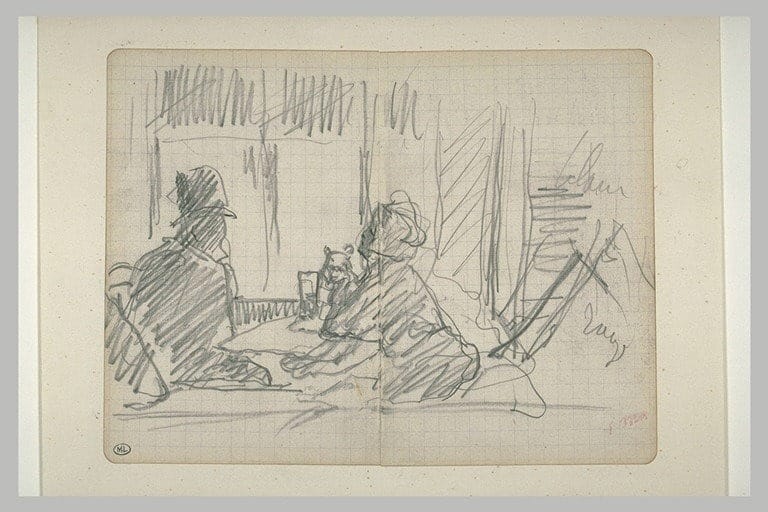
The habit is old enough to have been drawn by Manet. In the Louvre's collection of prints and drawings there is a pencil study catalogued as Couple avec chien, à une terrasse de café: a man in a hat, a woman across the table, and a small dog between them, sitting up as if it expects to be served next.

Where the Welcome Stops
Discretion cuts both ways. A restaurant may refuse your dog without giving a reason, and the law itself keeps one group of dogs out entirely. Under the dangerous dog rules in the Code rural, set out on the government's Service Public site, dogs of the first category, the attack types, are barred from public transport, from public places other than the street, and from premises open to the public, which includes every restaurant and café. Second category dogs, the guard and defence types, may go in, but must be on a lead and muzzled.
At the other end sits a dog no restaurant may turn away. Article 88 of a law of 30 July 1987 gives guide dogs and assistance dogs free access to transport and places open to the public when they accompany a holder of the mobility inclusion card, and a government answer to a deputy's question in 2023 confirms that refusing them is punishable by a fine of up to €450. The same exchange admits the refusals still happen, with restaurants named in the question among the offenders. A pet dog depends on goodwill; an assistance dog has the law on its side.
The welcome also stops at the grass. Paris, where a dog can share your table at lunch, still keeps it off the lawns. The city's own page now lists 165 green spaces open to dogs on a lead, on the paths and never on the lawns or flower beds, plus 45 fenced areas where they can run off the lead, and a €135 fine for leaving mess behind. In France the dog is a guest at the table long before it is a guest on the lawn.
The Dogs Paris Buried
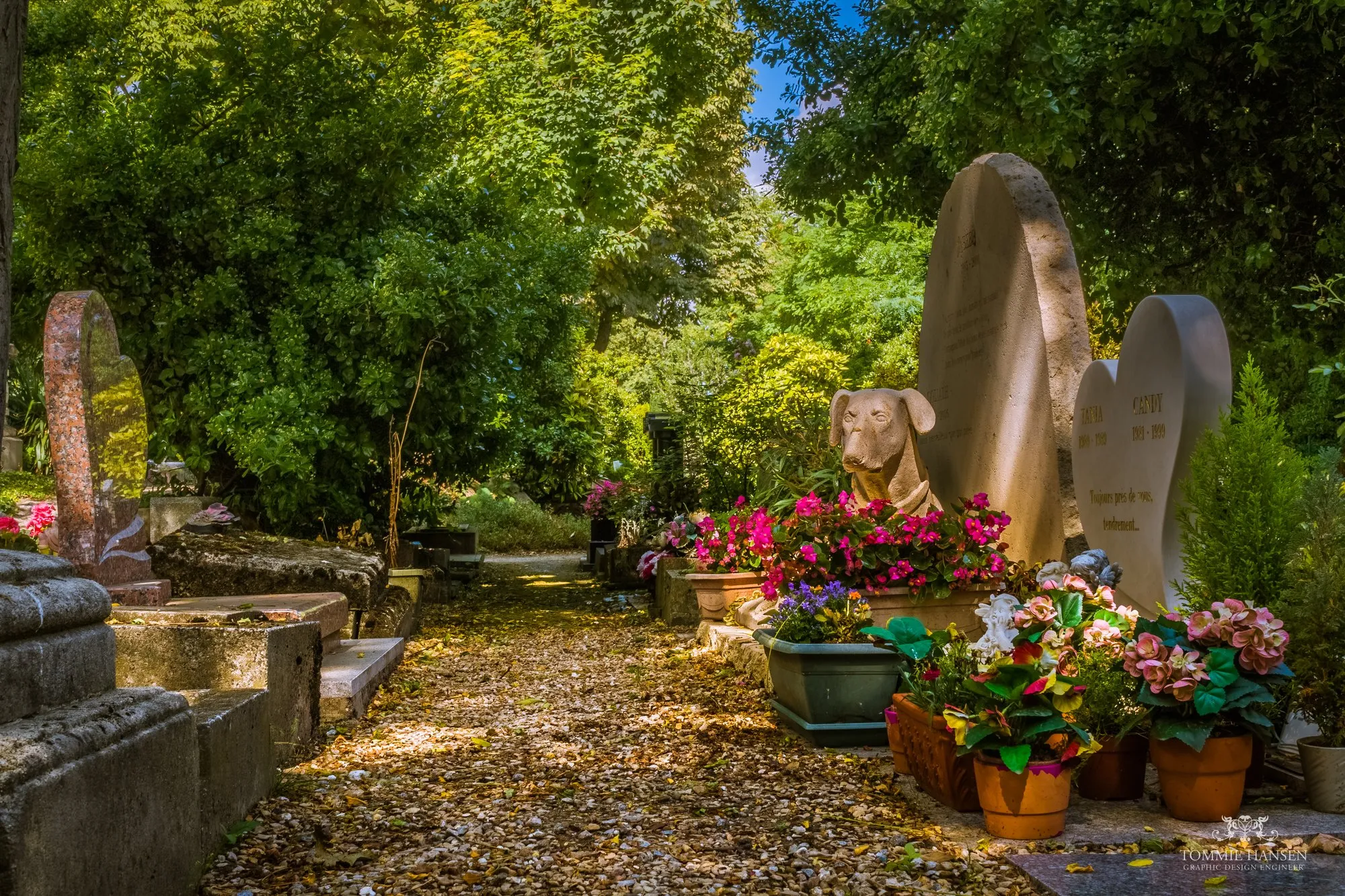
If you want the measure of how the French feel about their dogs, go out to Asnières-sur-Seine, in the Hauts-de-Seine. A law of 1898 allowed animals to be buried, and in 1899 the lawyer Georges Harmois and the feminist journalist Marguerite Durand opened the Cimetière des Chiens at 4 Pont de Clichy. Its 40,000th burial, in 1958, was a stray dog that died at the gates.
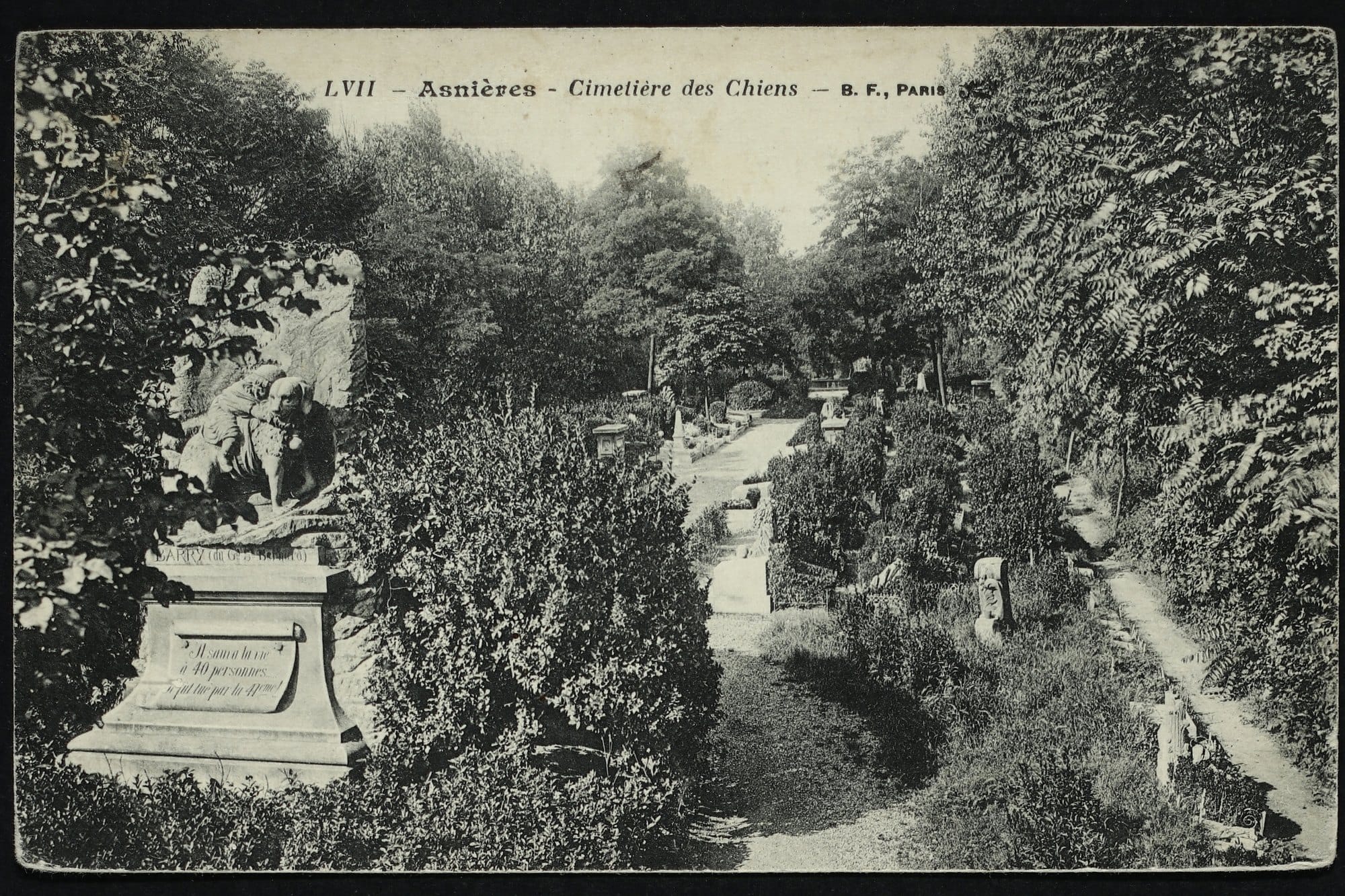
Inside is a monument to Barry, the St Bernard of the Great St Bernard hospice credited with saving 40 people, whose real story we told in Barry and the Dogs of the Great St Bernard Pass. Barry is not buried there; his body is in the museum in Bern. Rin Tin Tin is. Visit Paris Region lists the cemetery as open from 10am to 4.30pm every day except Mondays and most public holidays, until 6pm from mid March to mid October, at €3.50 for an adult.
Before You Sit Down
None of this makes a French restaurant a dog's by right. It makes it the owner's call, and the owner's call is usually generous, so it still pays to ask at the door rather than walk straight in, to keep the dog on the floor and quiet, and to expect a firmer line in food shops than in brasseries. For the rules country by country, our guide to eating out with your dog sets them side by side. For where to go once you are there, start with our Paris city guide, and for the crossing itself, taking your dog from the UK to France. The dog under the brasserie table is not there because of a special French law. It is there because nobody ever saw the need for one.

Kali Concierge
Travelling with your dog? Ask Kali.
Where your dog is genuinely welcome to stay, eat, drink and walk in 50+ countries, how to cross borders with the right paperwork, and calm emergency medical advice with the nearest 24-hour vet. Free, day or night, in any language.