
Nobody Trusts Pet Friendly
Using a label that misleads one group while excluding another is a bad marketing habit that nobody bothered to think about. Hotels like to call themselves "pet friendly," but which pets? Nobody really knows.

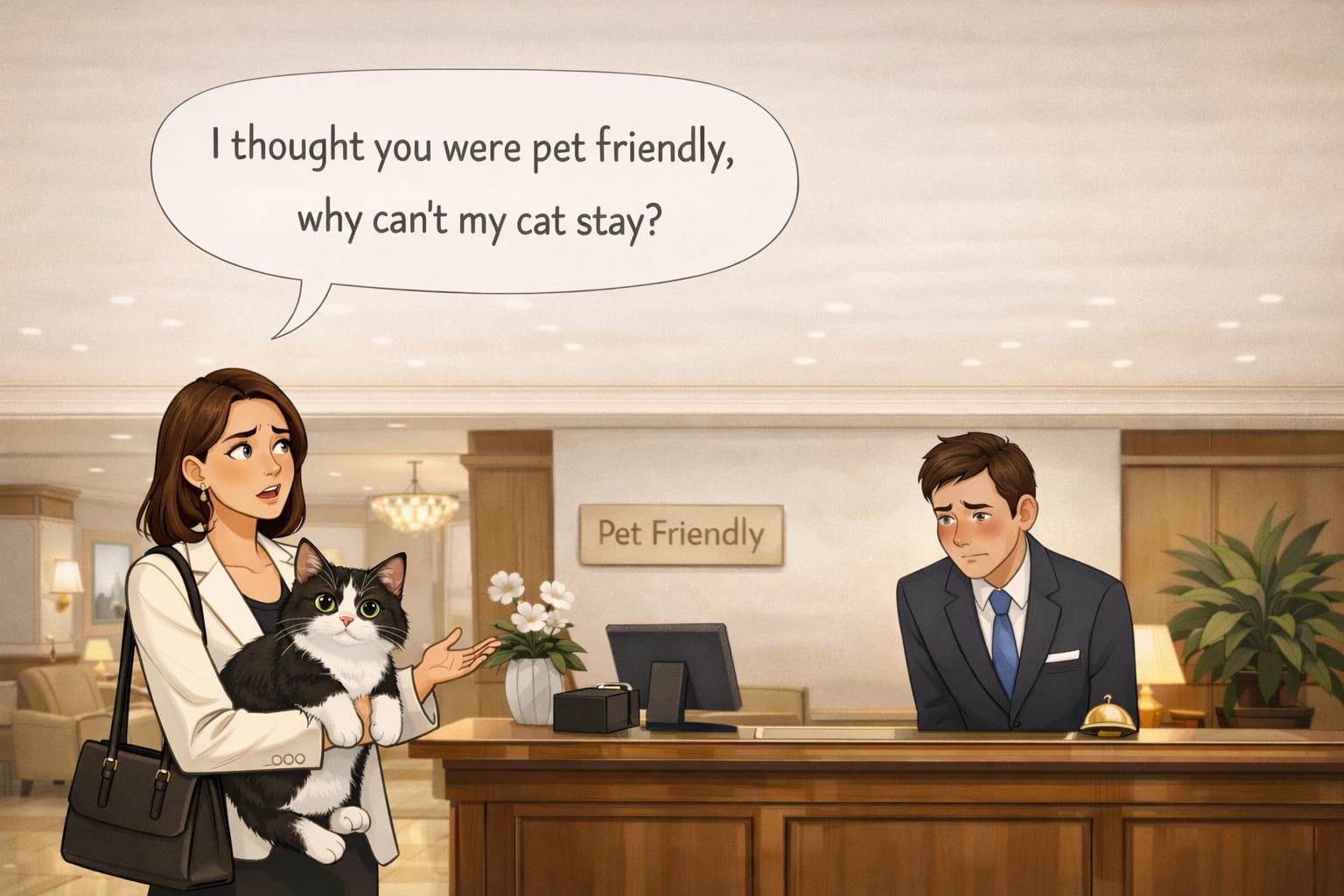
The travel industry has let a simple phrase do far too much work. "Pet friendly" appears everywhere. Hotel websites, booking platforms, search filters, OTA listings. It sounds reassuring. Inclusive. Clear. But it is none of those things. It is a label that signals certainty while delivering none. And somehow, nobody seems to have noticed. Or if they have, nobody has done anything about it.
The problem is almost embarrassingly straightforward. "Pet friendly" has never been defined. Not by regulators, not by the industry, not by the platforms that plaster it across millions of listings every day. It is a phrase built on assumption rather than agreement. And in the absence of a shared definition, every hotel on the planet is free to decide what it means for themselves.
That might sound harmless. It is not. It is chaos wearing a smiley face.
In practice, "pet friendly" almost always means dogs. Even then, it rarely means the same thing twice. One hotel uses it to mean all dogs are welcome, regardless of size or breed. Another means small dogs only. Another allows dogs, but not in public spaces or in the room on its own. Another requires advance approval and a photograph of your dog looking well-behaved. Another charges a fee so steep you start wondering if the dog gets its own room. Another has no written policy at all and decides on the spot based on what appears to be vibes.
All of them use the same two words.
From the guest's perspective, this creates a system that looks standardised but behaves like a lucky dip. A traveller filtering for "pet friendly" on a booking platform expects a baseline level of consistency. What they get is a mixed bag of policies, restrictions, and caveats that only become clear after clicking through multiple listings, squinting at fine print, or picking up the phone and asking a receptionist who also seems unsure. It is friction disguised as convenience.
A search filter that creates more questions than it answers.
For dog owners, the core issue is unpredictability. You might assume your dog is welcome, only to discover weight limits, breed restrictions, or access limitations that were nowhere to be seen at the point of booking. You packed the travel crate. You booked the room. You drove four hours. And now someone behind a desk is explaining that your Labrador is "too large" for the pet policy. That is not a good moment for anyone involved, including the person behind the desk.
For cat owners, the situation is worse.
Most have learned through bitter experience that "pet friendly" does not apply to them at all. The term includes them in theory and excludes them in practice. It is like being invited to a party and arriving to find the door locked.
This is where the phrase falls apart completely. A label that appears inclusive but functions selectively is not just vague. It is misleading. And the industry has been getting away with it for years, mostly because nobody thought to question two perfectly innocent-looking words sitting next to each other on a website.
"Pet friendly" is just a label. See the standard →
The data backs this up. When hotels that describe themselves as "pet friendly" are assessed against their actual policies, only a small minority accept cats. The overwhelming majority accept dogs only, yet continue to use a term that implies broader coverage. The gap between language and reality is not small. It is structural, and it has been hiding in plain sight.
So why does this persist?
Because it is easy. Wonderfully, irresistibly easy.
"Pet friendly" is a low-effort marketing signal. It requires no precision, no commitment, and no verification. It allows properties to capture demand from travellers with animals without being held to any consistent standard. It is flexible in a way that benefits the operator, not the guest. And nobody is checking.
Platforms make it worse. Booking sites aggregate listings under a single "pet friendly" filter without distinguishing between radically different policies. A hotel that welcomes all dogs with open arms and a hotel that reluctantly permits one small dog under strict conditions and a withering look from the concierge are treated as equivalent. The filter promises a category. What it delivers is a collection of unrelated policies wearing the same name and hoping nobody notices.
In most parts of the travel industry, this kind of ambiguity has already been addressed. Star ratings, accessibility standards, safety requirements. These are defined, audited, and increasingly transparent. They may not be perfect, but they are anchored in shared criteria. They give the guest something to rely on beyond hope and the mood of whoever is working behind reception today.
"Pet friendly" never made that transition; it remained informal, unregulated, and open to interpretation. And as the number of travellers with dogs has grown, the cost of that ambiguity has grown with it. What was once a niche concern is now a mainstream expectation. More people travel with dogs. More people expect clarity. More people rely on filters and categories to make decisions quickly.
But the underlying label has not evolved. It is still doing the same nothing it has always done, just at greater scale. A functional category requires three things: a clear definition, consistent application, and the ability to verify compliance. Without those, it is not a category. It is a suggestion.
A gentle, noncommittal wave in the general direction of meaning.
Right now, "pet friendly" fails on all three counts.
There is no agreed-upon definition of what it includes. There is no consistency in how it is applied. And there is no mechanism to ensure that what is claimed matches what is delivered. It is the hotel industry's most popular honour system, and it is completely broken. Fixing this does not require complexity. It requires precision.
Instead of a single, overloaded term, the industry needs defined criteria. What animals are accepted? Under what conditions? With what restrictions? Are there size limits, breed limits, access limitations, additional fees? These are not edge cases. They are the questions every traveller with an animal needs answered before they book. And right now, the answer to most of them is "it depends".
Which is not an answer at all.
Once defined, those criteria need to be standardised. Not in a way that forces every hotel to offer the same thing, but in a way that ensures they describe what they offer using the same framework. A hotel that accepts all dogs should be clearly distinguishable from one that accepts small dogs only. A hotel that allows animals everywhere should be distinguishable from one that restricts access to the room and treats the lobby like a demilitarised zone.
Clarity does not reduce flexibility. It makes flexibility visible.
And finally, there needs to be verification. A label only works if it can be trusted. If "pet friendly" continues to be self-declared without oversight, it will continue to drift. Standards only matter when they are upheld, even lightly. Otherwise, they are just words on a page, and we already have plenty of those.
None of this is radical. It is how every other meaningful classification in travel already works. The surprising part is that it has not happened yet. The pet travel market has grown into a multibillion-dollar segment, and it is still running on a term that nobody bothered to define. That is not charming. It is a problem.
The industry can keep using "pet friendly" as is and accept the confusion that comes with it. Or it can define it and turn it into something that actually works.
Not all dog friendly hotels are equal. See ours →
That is what our new dog friendly standard does. Roch Dog is defining criteria, making independent assessments, and rating hotels from A+ to F in a way that tells travellers what a hotel actually offers before they book, not what it claims.
The industry had decades to prove pet-friendly meant something. It didn’t.
The Dog Friendly Standard does.