
Where Your Dog Can Walk in America's National Parks
America's national parks let dogs in, but each park draws its own line. In Shenandoah a dog can hike most trails; in Yellowstone it must stay within 100 feet of a road. The federal leash rule, the open parks, the strict ones, and the B.A.R.K. Ranger tag.
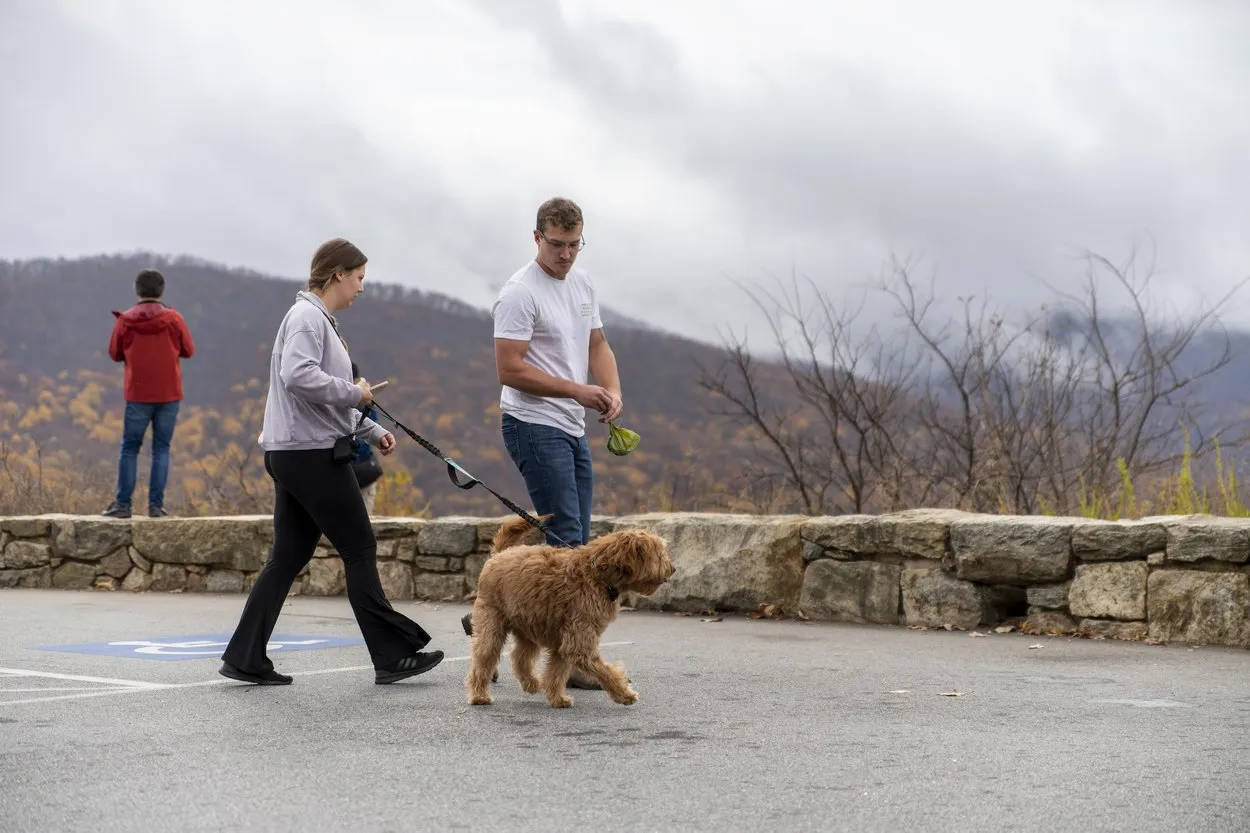
In Shenandoah National Park in Virginia a dog on a lead can walk almost every trail, more than 480 miles of them. In Yellowstone the same dog may not set a paw on a single hiking trail or boardwalk, and must stay within 100 feet of a road, car park or campground. Both are run by the National Park Service, and both follow the same federal rule book. The difference is that each park draws its own line on where a dog may go, and that line is the thing to know before you load the car.
The Rule Every Park Shares
The floor is federal law, 36 CFR 2.15, and it applies in every park the service runs. A dog must be on a leash no longer than six feet, or crated, caged or otherwise physically confined, at all times. Dogs are barred from public buildings, from public transport such as park shuttles, and from any spot marked as a swimming beach. A dog may not be left tied to a post or a tree outside designated areas, and barking or howling that disturbs people or frightens wildlife is an offence in itself. Guide dogs and hearing dogs are exempt from the building and transport ban.
The National Park Service pets page puts the welcome plainly: pets are welcome in developed areas, on many trails and campgrounds, and in some lodging. The word that matters is many. Its planning page tells you that different parks have different rules and that you should check each park's own website before you travel. That park's own pets page is the one to trust, and every park in this guide keeps it under Plan Your Visit.
The Parks That Open Their Trails
Shenandoah is the generous one. Leashed dogs are allowed on most of its trails, and the ones closed to them come to fewer than 20 of more than 500 miles. The closures are Old Rag and its approaches, Dark Hollow Falls, Bearfence Mountain, Limberlost and Frazier Discovery among them. On Stony Man a dog may walk the first stretch, which follows the Appalachian Trail, but may not turn onto the blue-blazed summit path. Campgrounds take dogs, and the park says there is lodging that takes them.
Acadia on the Maine coast opens 100 miles of hiking trail and 45 miles of its carriage roads to dogs. The exceptions are the cliff routes, the Precipice, the Beehive, Beech Cliffs, the Perpendicular Trail, the Ladder Trail to Dorr Mountain and part of Jordan Cliffs, and the park asks you to keep a dog off any ladder or rung trail and carry plenty of water. Sand Beach is closed to dogs from 15 June to 8 September and Echo Lake from 15 May to 15 September, and nobody, dog or person, may swim in most of Acadia's lakes, because they are public water supplies. Blackwoods, Seawall and Schoodic Woods campgrounds all take dogs.
At Wilson's Creek National Battlefield in Missouri, leashed dogs are welcome on the tour road and every hiking trail. Only the visitor centre and the Ray House are off limits to them.
The Parks That Keep Dogs to the Road
Yellowstone is the strictest of the famous parks. Dogs are allowed only in developed areas and within 100 feet of roads, car parks and campgrounds. They are not allowed on boardwalks, hiking trails, in the backcountry or in thermal areas, and carrying the dog in your arms, a backpack or a pram does not change that. The park gives its reasons: bears and coyotes kill pets, dogs are burned or killed in hot springs, and domestic animals and wildlife pass diseases to each other. There are no kennels inside the park, only in the towns around it.
Rocky Mountain National Park bans dogs from every trail, all tundra and every meadow. A leashed dog may go along the roads, in car parks, campgrounds and picnic areas. For a hike with a dog, the park points you outside its boundary to the Arapaho and Roosevelt National Forests, the multi-use trails around the town of Estes Park and Larimer County's open spaces. If Denver is your base, our Denver city guide covers the city side of the trip.
Mount Rainier works the same way: no dogs on any trail or in wilderness, and none on snow, in buildings or in amphitheatres. Dogs may use car parks, campgrounds and paved roads open to traffic, staying within six feet of the tarmac. The one exception is the Pacific Crest Trail along the park's eastern edge, where a leashed dog may walk. The Seattle city guide is the place to plan the rest.
The Parks in Between
Yosemite lets dogs onto fully paved roads, pavements and bicycle paths, which takes in the Bridalveil Fall and Lower Yosemite Fall trails, the paved Cook's Meadow loop and the paved road to Mirror Lake. Unpaved trails are closed to dogs, Vernal Fall included, even if you carry the dog, with one exception: the Wawona Meadow Loop. Dogs may not ride the shuttles or stay in the lodging areas, Housekeeping Camp included, and may not use Camp 4 or the group sites; every other campground takes them.
At Zion the only trail open to dogs is the Pa'rus Trail, which starts at the Zion Canyon Visitor Center. Dogs cannot ride the park shuttle buses, and the park bans retractable leads that run out past six feet. Kennels are in Hurricane, St. George, Kanab, Cedar City and Rockville.
At the Grand Canyon, leashed dogs may walk the trails above the South Rim but may not go below it. On the North Rim they are limited to the bridle trail that links the North Kaibab Trail with the Arizona Trail, and the Arizona Trail north to the entrance station. Yavapai Lodge is the only lodge in the park with rooms for dogs, and the Grand Canyon Kennel on the South Rim boards dogs by the day or overnight, with reservations recommended.
Cars, Heat and Leaving the Dog
Leaving the dog is the other thing to plan. Yellowstone allows a dog to wait in the car for short periods, but recommends someone stays with it, and forbids leaving a dog without enough food, water, shade or ventilation. Rocky Mountain warns that dogs left in cars can overheat and die, and that a cracked window does little. Our guide to heat and your dog on holiday has the figures, and walking and hiking with your dog covers wildlife and water on the trail. In the strict parks the honest plan is a kennel for the day you want the backcountry, and the national forest next door for the day you want to walk together.
The B.A.R.K. Ranger Tag
The park service turned its rules into a pledge your dog can take. B.A.R.K. Ranger stands for Bag your pet's waste, Always leash your pet, Respect wildlife and Know where you can go. Each park runs its own version: some offer a walk with a ranger, some a pledge, some an honour system. At Wilson's Creek you collect an activity pamphlet from the visitor centre desk, complete it with or without the dog beside you, and bring it back for the dog's own bark ranger tag.
Kali Concierge
Travelling with your dog? Ask Kali.
Where your dog is genuinely welcome to stay, eat, drink and walk in 50+ countries, how to cross borders with the right paperwork, and calm emergency medical advice with the nearest 24-hour vet. Free, day or night, in any language.