
Dog Friendly vs Pet Friendly
Between 2022 and 2025, US search interest in pet friendly hotels fell 19% while dog friendly hotel rose. The specific word is outperforming the vague one, and the reasons should concern every hotel marketer.
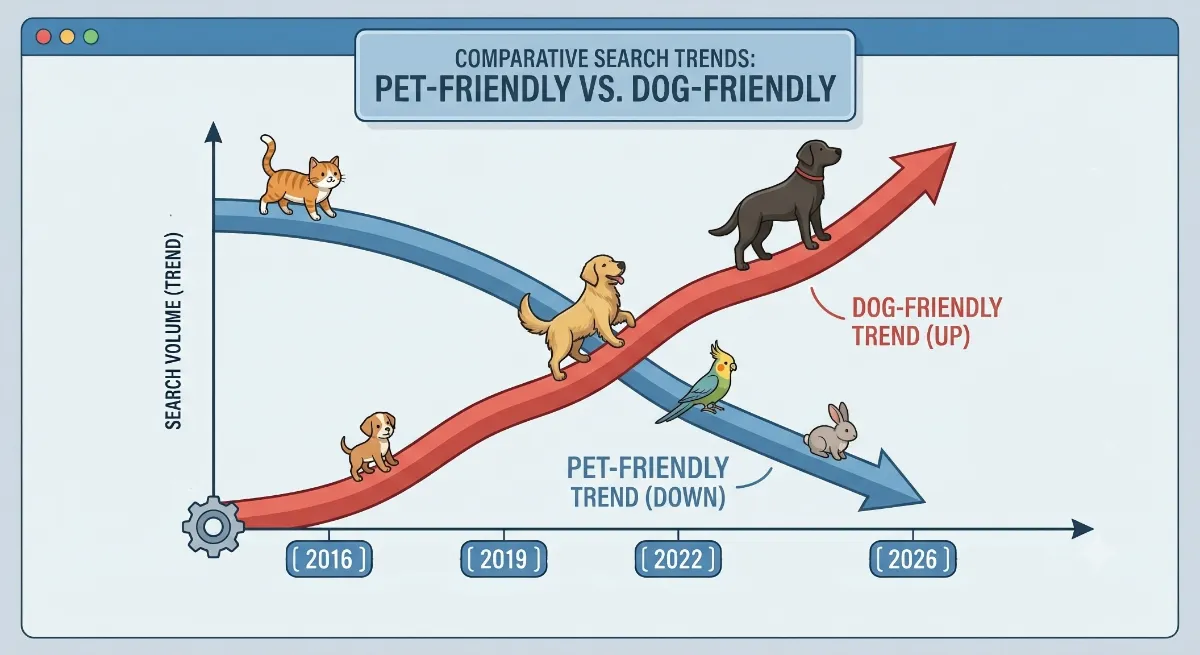
Two words are quietly winning a fight the hotel industry has not noticed it is in. Between 2022 and 2025, US search interest in "pet friendly hotel" fell 19%. Over exactly the same period, "dog friendly hotel" climbed from 45% of the larger term's interest to 58%. The bigger term still wins on raw volume, but the gap closes every year, and the direction has not wavered.
The chart is free on Google Trends and takes under a minute to check.
That is not a story about people travelling less with their animals. Pet travel grew across those four years. It is a story about which words people choose when they want something specific.
But the American chart is the least interesting one, and we had been reading it wrong. It is not a forecast. We went and pulled the same comparison for every major market, thirty-three of them across fourteen countries and six languages, back to 2016. The shift is not coming. In most of the world it has already happened, and the United States is close to last in the queue.
Britain Finished This Argument A Decade Ago
In the United Kingdom, "dog friendly hotel" outsearches "pet friendly hotel" by more than four to one. Strip out the word hotel and compare the bare terms and the ratio is seven to one. That is not a recent flip. British searchers had already made the switch before 2016, which is as far back as we pulled, and the gap has widened every year since.
Between 2022 and 2025, UK interest in "pet friendly" fell another 25%.
Ireland crossed over in 2018. Australia crossed in 2023, and by 2025 the dog term led by 37%. Canada has not crossed yet but is moving fast, with "pet friendly" down 25% in three years.
Set the five English-speaking markets side by side and the pattern is not subtle.
Every single one shows "pet friendly" falling between 2022 and 2025, by 16% at the slowest and 29% at the fastest. Every single one shows "dog friendly" holding flat or growing over the same window. There is no market where the broader word is gaining ground on the narrower one. Not one.
The United States is not leading this trend. It is lagging four other markets, and on the bare terms it has moved from 55% to 93% in ten years, which puts it within touching distance of the crossover Australia passed in 2023.
The British present is the American near future. That is worth saying to an American hotelier plainly, because the UK is not a curiosity. It is a preview.
Europe Never Used The Word At All
Then it gets stranger. Run the comparison in native languages and the premise of the debate disappears.
In German, "hotel mit haustier", the direct equivalent of a hotel with a pet, registers at effectively zero for the entire decade. Not low. Zero, against a dog equivalent running steadily near the top of the scale. Dutch behaves identically. In those languages nobody has ever searched that way.
Italian favours the dog word by roughly five to one. French by two to one, and it crossed over before our window opens.
So across the four largest continental European markets there is no meaningful contest. The pet-generic phrasing either lost long ago or was never used. The industry standard label for a hotel product describes the way almost nobody in Europe looks for it.
The Term Was Never Describing The Product
Language does not drift for no reason. It drifts when a word stops matching the thing. "Pet friendly" fails first as a description, before it fails as a promise. Across the hotels we have assessed at Roch Dog, fewer than a third accept cats. The overwhelming majority accept dogs, and only dogs. The typical property calling itself pet friendly is running a dog operation and describing it with a word that promises considerably more.
Look for the habit and you see it everywhere. Hotels publish thousands of words about dog beds, dog bowls, dog menus and dog walking routes without using the word "dog" once, all of it filed under a label about pets in general. Most hotels are talking about dogs. They are simply not saying so.
Guests notice. Almost nobody calls their dog a pet in conversation, and nobody outside a marketing department says "pet parent". When a hotel reaches for that vocabulary, the reader hears a business that has not thought about them specifically, which is an odd first impression to give the guest you most want.
Vagueness Stopped Working
The migration towards the narrower term is not fashion. It is dog owners routing around a word that failed them, and the public record of that failure is long and dated. In 2015, a guest at the Grand Galvez in Galveston paid a $100 non-refundable fee, was told the dog could not use the grass, then was asked to leave the lobby. Their review read: "They allow pets but are not pet friendly." Ten years later, a guest at a Myrtle Beach resort arrived independently at the same sentence: "Pet allowed but not Pet friendly. There is a difference."
In between, that verdict became a genre. "Not pet friendly, pet tolerant!" is a review title at a Niagara Falls hotel. "Not Pet Friendly, Just Pet Tolerant" at a Michigan motel. "Not really pet friendly!" at the Bellagio in Las Vegas. The same conclusion, in nearly the same words, from the budget end of the market to the luxury end, written by people who have never met.
The surveys agree with the reviews. Wag's national survey of 1,002 pet owners found 84% had hit at least one problem with overnight accommodation, and 48% describe hotel stays with a pet as difficult. Mars reports that a third of owners have altered travel plans outright because travelling with an animal is too hard.
Our own assessment data says the same thing from the other side. We have assessed more than 3,000 hotels against a published standard. 49% score D or F. The most common failure is the one guests complain about most: no access to any indoor shared space, which is a room that tolerates a dog rather than a hotel that welcomes one. So travellers changed their search.
A person typing "dog friendly hotel" has already decided that the broader word cannot be trusted to mean anything, so they avoid it.
The Keyword You Cannot Win Against
Here is where the language shift becomes a budget decision. "Pet friendly hotel" looks like the obvious term to chase because of its volume. It is also among the hardest terms in travel to rank on, because it was captured a decade ago. Expedia, Booking, Hotels, Kayak, Trivago and Google Hotels have built enormous programmatic libraries around every variation of the phrase, and the established directories hold years of accumulated authority.
A hotel publishing another pet friendly page is not competing with the property across the street. It is competing with billion-dollar aggregators, on their strongest term, in their language, and it will lose. Worse, it will be outranked by the very intermediaries that charge it commission on the booking they intercepted.
Stated plainly, the prevailing strategy is to optimise for a term that is declining in your market, against competitors you cannot outrank, in language your customers have stopped believing, to describe an animal you do not name. Nobody would approve that plan if it were said out loud in a meeting. It survives because it is never said out loud. The specific term is winnable. It carries higher intent, it faces thinner competition, and it matches what the person actually wants.
The Guest You Are Losing Is The Best One
The traveller migrating to the narrower search is the most valuable guest in the building. Dog owners stay longer than average. They spend more on food and beverage, largely because they will not leave the dog alone in the room, so they eat where they sleep. They return at rates well above the industry benchmark, because once they find a property they trust, they stop looking.
That loyalty is unusual in leisure travel and it compounds.
Three quarters say they would pay more for accommodation that genuinely delivers on its dog friendly claims, and 64% would pay up to $50 more per night. The willingness is already there. What is missing is a reason to believe any particular hotel. This segment is one of the few in hospitality growing against a softening market. There is a revenue surge in this industry, it has a species, and the industry's own marketing language refuses to name it.
Saying Dog Friendly Is Not Enough On Its Own
There is an obvious trap here, and hotels should walk into it with their eyes open. If the industry simply swaps one undefined adjective for another, the new word rots exactly like the old one did. "Dog friendly" typed on a website by the hotel about itself carries no more evidence than "pet friendly" did. The reason the original term collapsed is not that it was too broad.
It is that nobody ever had to prove it.
The Hong Kong government put this on the record in April 2025, stating officially that pet-friendly venues are self-described and that "there is no specific or consistent definition of this type of restaurants". That is a state conceding that a term in widespread commercial use means nothing in particular.
Every other quality signal a hotel displays has a body behind it. Fire safety is regulated. Food hygiene is inspected. Star ratings follow agreed criteria. Dog hospitality has had no equivalent, so hotels self-declare and guests have no benchmark. What makes the specific word outperform is specificity plus proof. Say dogs, then publish what that means, then let somebody independent check it. That is what the Roch Dog Friendly Standard exists to do.
What Actually Changes On Monday
Most hotels cannot abandon the old label everywhere. OTA categories are built on it and corporate templates enforce it. Those constraints are real, and they do not matter as much as they appear to, because they do not touch the channels a hotel owns.
The website is yours. The policy page, the FAQ, the Google Business Profile, the booking page and the reception script are all yours. Those are precisely the surfaces where being specific wins.
So if your property welcomes dogs, say dogs. Say which dogs, at what weight, in which spaces, at what cost and how many. Answer the questions guests currently have to telephone you to ask, and answer them before booking, in writing, with the same answer whoever happens to be on the desk that evening.
Every one of those phone calls is a guest who was not confident enough to book. Behind each caller are others who never called and quietly booked somewhere they trusted instead. Answering in advance converts both.
The search data says travellers have already moved. In Britain, Ireland and Australia they finished moving years ago. In Germany and the Netherlands they never used the other word at all. The industry can meet them there, or it can keep optimising for a term its own customers stopped believing.
Call a dog a dog, and then prove it.
A Note On The Data: All figures come from Google Trends, pulled in July 2026 across thirty-three term comparisons in fourteen markets, covering 2016 to 2025. Google Trends reports relative search interest on an indexed scale rather than absolute query counts, so every figure here describes how two terms move against each other rather than how many people searched. Comparisons are normalised within a single query, which means ratios and within-market changes are meaningful while raw index values from different countries are not.

Kali Concierge
Travelling with your dog? Ask Kali.
Where your dog is genuinely welcome to stay, eat, drink and walk in 50+ countries, how to cross borders with the right paperwork, and calm emergency medical advice with the nearest 24-hour vet. Free, day or night, in any language.