
Kennels or Come Along? What the Stress Studies Actually Measured
Researchers measured 29 family dogs at home and then in boarding kennels: stress hormone up, noses colder, more on the move. They still could not say the dogs were unhappy. What the kennel and shelter studies show, and why the first days count either way.
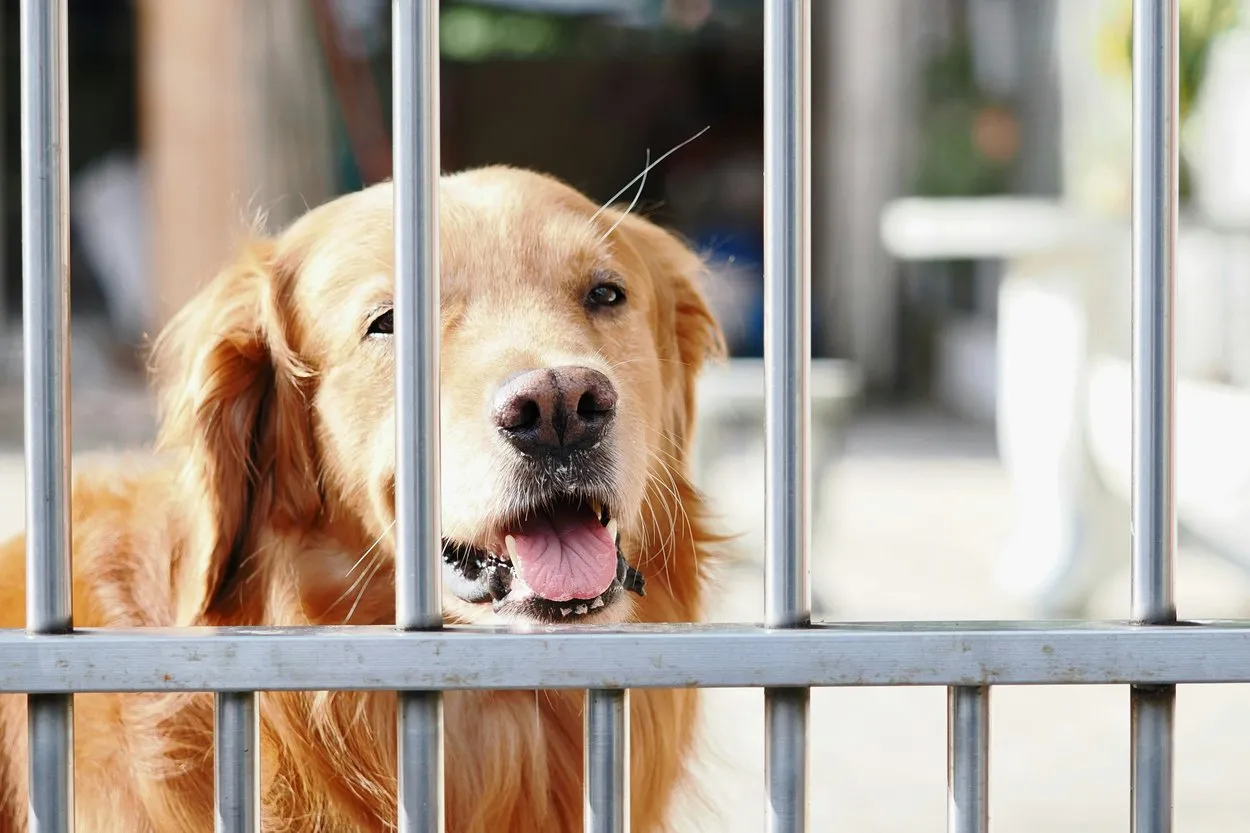
Twenty nine family dogs in Northern Ireland were put through the same examination twice, once at home and once during a stay at one of three private boarding kennels. Someone collected their urine, took the temperature of their noses, weighed what they ate and watched for lip licking, yawning, paw lifting and shaking. Fourteen were male and fifteen female, of a range of ages and breeds, and the order of the two stays was balanced across the group, some dogs boarding first and some starting at home, so that going first or second could not tip the result. The researchers wanted to know what a stay in kennels does to a dog, and how anyone could tell.
The answer, published in Physiology & Behavior in 2014 by C.E. Part, Lisa Collins and colleagues from Queen's University Belfast, Lincoln, Birmingham and the Royal Veterinary College, is the paper most often quoted when an owner asks whether a dog minds being boarded. It is quoted more confidently than its authors ever wrote it, and the gap between the two is the useful part.
What Changed in the Kennel
Several things moved, and moved clearly. The ratio of cortisol to creatinine in the dogs' urine, the most widely used hormonal measure of stress in dogs, was higher in kennels than at home. So was a second measure, a breakdown product of adrenaline. The dogs' surface temperature, read at the nose, was lower in kennels, and the difference had nothing to do with how warm or cold the kennel itself was. Most dogs were more active there too, though some far more than others.
None of the changes could be put down to exercise: the hormone rises were not linked to how much more the dogs moved about. Nor did age, sex, which kennel a dog stayed at, or whether it had been boarded before make any difference. A seasoned boarder and a first timer showed the same shifts. It sounds like proof that kennels are stressful. The authors read it another way.
Arousal Is Not the Same as Distress
Cortisol rises when a body gears itself up, and a body gears itself up for good reasons as well as bad ones: a run, a game, a new place full of smells. The hormone tells you that a dog is aroused. It does not tell you whether the dog is frightened or delighted. The University of Lincoln's own account of the study, reported on Phys.org, puts it plainly: cortisol levels "appear to provide an indication of arousal without specifying the emotional reason of that arousal."
Lisa Collins of the University of Lincoln said the dogs "appeared to have a higher level of overall arousal or excitement in kennels compared with their state at home", but that "this arousal is not necessarily due to dogs experiencing kennels as negatively stressful." Her team found "no definitive evidence" that the dogs were stressed in a bad way, and suggested instead that they may have treated the kennel as "an exciting change of scene, at least in the short-term." David Morton, the Birmingham professor on the team, made the wider point in his university's release: "the measurement of stress is not straightforward and open to interpretation as arousal can occur for both positive as well as negative reasons."
One detail ran against expectation. In kennels, the dogs with higher cortisol licked their lips less, not more, though lip licking was one of the behaviours watched as a possible sign of unease. The authors' conclusion was that the hormones and the cold nose are good gauges of how worked up a dog is, and that only watching the individual dog says what that feeling is.
The study has limits. It covered short stays at three private kennels, and 29 dogs is a small group. It shows that kennels change a dog's body in ways that look like excitement as much as fear, not that a long stay suits every dog.
The First Three Days
The other study owners meet, usually secondhand, comes from a different building. In 1997 Michael Hennessy and colleagues at Wright State University in Ohio measured cortisol in the blood of dogs at a county animal shelter: dogs taken into a public shelter, not family pets dropped off for a fortnight. The difference is often lost when the paper turns up in arguments about boarding.
It found a pattern in time. Dogs in their first three days had higher cortisol than dogs there more than nine days, with days four to nine in between. The same dogs had less cortisol on day four or five than on their first day, and on that first day they had more than a group of pet dogs sampled in their own homes. Confinement, the authors concluded, keeps the body's stress system switched on for some time.
Twenty minutes of petting made no overall difference to the dogs in their first three days, with one odd exception: dogs petted by a woman ended the session with lower cortisol than dogs petted by a man. A later study from the same lab, by Matthew Shiverdecker, Patricia Schiml and Hennessy in 2013, tried longer sessions with dogs in their first 40 hours at a shelter. Half an hour with a person, whether the person simply sat there, stroked the dog or played with it, brought a substantial and near uniform fall in cortisol, along with less vocalising and less panting. Dogs left alone in the same quiet room, or left where they were housed, showed no such fall.
None of this should be stretched to a boarding kennel: a shelter dog has lost its home, a boarded dog has one waiting. But the shape of the curve, highest at the start and easing after the third day, and the calming effect of time spent with a person, are the parts most likely to carry over to any dog in a strange place.
Beside the Evidence on Travel
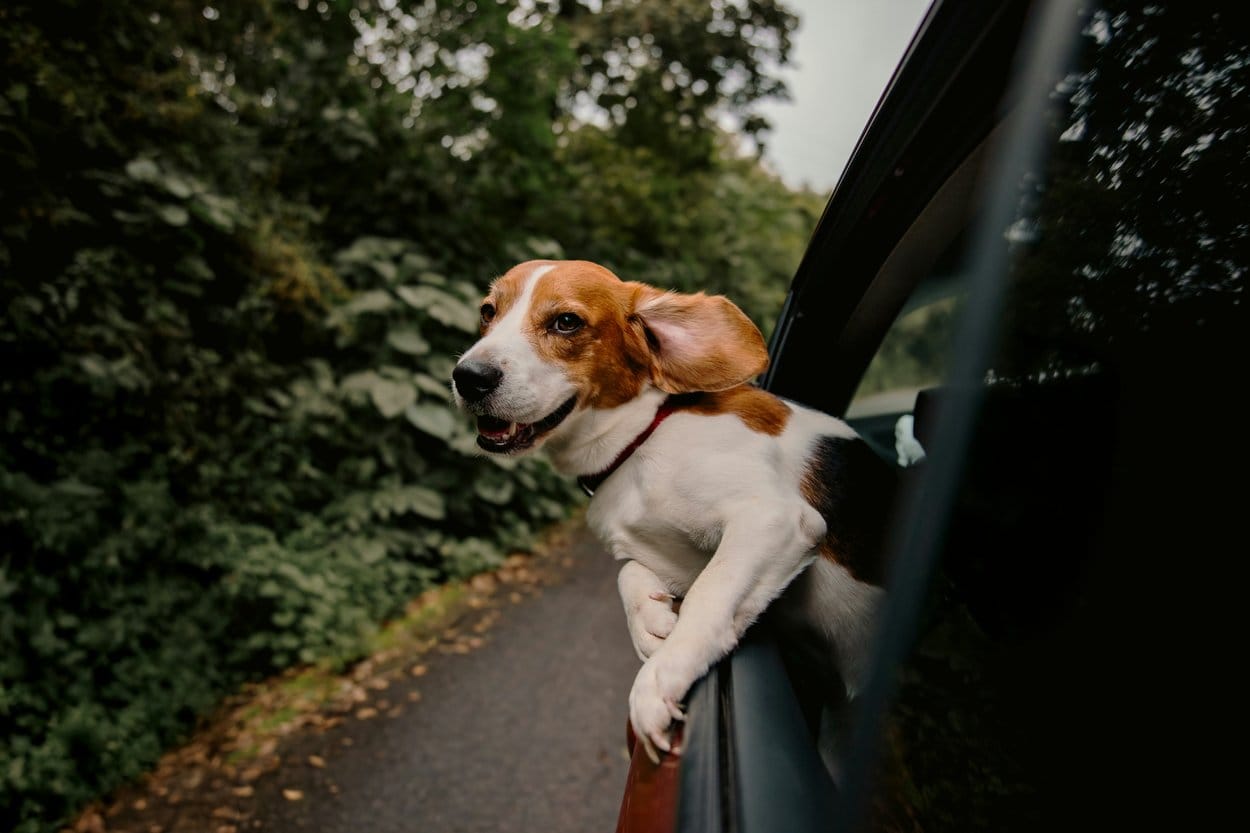
The studies on taking the dog along measure the same hormone and meet the same problem. In Vienna, beagles driven along the motorway in crates showed a rise in salivary cortisol on every trip, and the third week's drive produced no smaller a rise than the first; later work found at best a slow, partial easing. We went through all four car studies in Do Dogs Get Used to the Car? A higher cortisol reading after a drive carries the same caution as one in a kennel: it shows a body working harder, not what the dog made of it.
The first night somewhere new has its own evidence. Sleep recordings from Budapest, covered in Why Your Dog Sleeps Badly the First Night Away, found that family dogs sleep lighter and later in a strange room the first time, and that dogs used to sleeping away from home barely notice the change.
What the Studies Can Tell You
Side by side, the research crowns neither the kennel nor the back seat. It says that a new place, whether a boarding run or a hotel room, gears a dog up, that the hormone everyone measures cannot tell excitement from fear, and that the first two or three days are when the body is working hardest. It also says that experience helps on the road, and that time with a person settles a dog in a strange place.
Which choice is right is the owner's call, made with the one instrument no study has bettered: knowing the dog. A dog that lights up at a new place and new company is reading the kennel the way the Northern Ireland dogs may have done. A dog that frets in the car and sleeps badly away has its own answer. Either way, the first days are the hard part, and they pass.

Kali Concierge
Travelling with your dog? Ask Kali.
Where your dog is genuinely welcome to stay, eat, drink and walk in 50+ countries, how to cross borders with the right paperwork, and calm emergency medical advice with the nearest 24-hour vet. Free, day or night, in any language.